Hokkaido’s Grounded Lightness: Creating Architecture for Lasting Continuity in Japan’s Northern Frontier
It all began with a simple idea: a small space where people could gather, sit together, converse, and create.
In Hokkaido, expansiveness and proximity to nature coexist with constraints imposed by the region’s demanding climate. The long winters, the shifting light, and the quiet vastness of the northern terrain create a sense of both remoteness and possibility. In this landscape, architecture is never merely a shelter but a mediator, a device that frames the slow rhythms of weather, the colours of the seasons, and the human rituals that unfold within them. Our aim was not to design a structure that merely accommodates these conditions, but to go beyond, proposing an architecture that creates place and meaning, that enriches relationships, and that expands people’s imagination and possibilities.
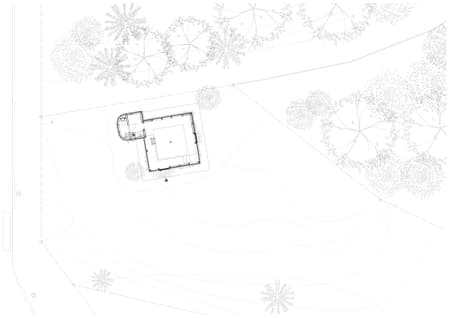
This small single-story pavilion was conceived as a place for people to meet and sit together. Taking Hokkaido’s harsh climate as a given, we sought not to distance ourselves from it but to generate new layers of relationship - between people, between people and nature, and between people and the elements that shape the built environment. In doing so, we hoped to redefine the boundaries that structure these relationships. While developing this modest, cost-conscious building, we often recalled the Japanese tearoom.
A tearoom is dignified yet straightforward. It brings nature into the space, places everyone on equal footing, and blurs the line between “room” and a collection of elemental parts. Its close scale and components invite behaviour, interaction, and awareness. This idea became a quiet reference point in our thinking.
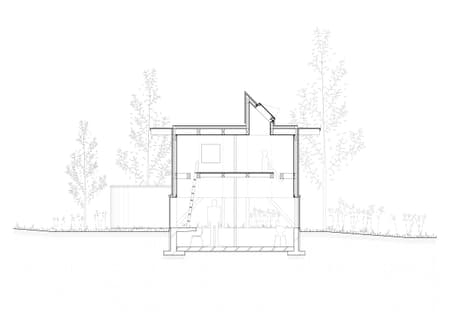
In Hokkaido, frost depth regulation determines how deep a foundation must be embedded in the ground, if it is insufficient, frost heave can crack or shift the structure. Typically, this buried portion becomes an unused crawl space, but we chose to activate it here. By lowering the building volume slightly deeper than the required frost depth, about 600 mm, we created two distinct base platforms. From the upper platform, we introduced continuous low openings on all four sides, functioning like ground-level windows that encourage walking, sitting, working, eating, and a wide range of behaviours while drawing the surrounding landscape into the interior. With openings so close to the earth, the body is exposed to the outside: in summer, greenery flows in, while in winter, one feels almost united with the snowfield while remaining indoors.
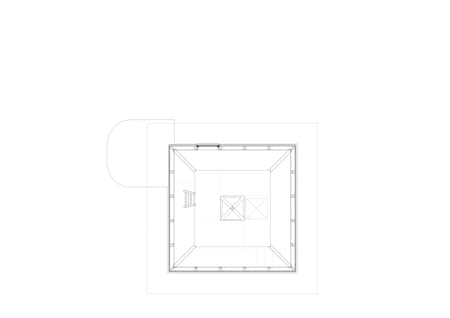
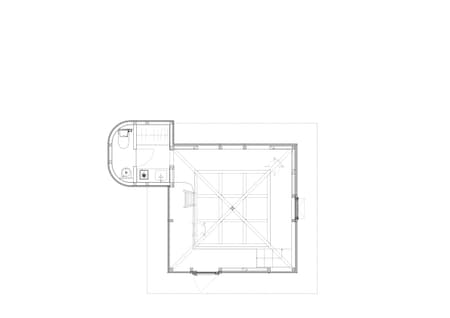
At the centre of the space stands a symbolic column rotated 45 degrees, intersected by an angled beam that organises the entire interior. This structure lifts the upper floor and creates a continuous void along all four perimeters, establishing vertical connection and expanding the space sectionally. The loft, in contrast to the open lower level, is a closed room defined by walls and ceiling, yet it still senses a faint presence of the exterior environment from below.
Within what is essentially a one-room space, the main architectural components - foundation, structural frame, windows, walls, floor, and ceiling - are simplified and dispersed. Joints between elements are either slightly detached or lifted, and a unified material palette allows each component to stand independently while coexisting. These clear, simple parts become intuitively legible and familiar, multiplying the number of human-scale relationships and generating dynamic proportions that subtly expand bodily perception.
The resulting architecture carries both the grounded strength of being embedded in the earth and the lightness created by floating openings. It is enclosed yet exposed, fragmented in its spatial niches yet somehow continuous. Its firm yet gentle form generates small places of refuge, encouraging a free, unprescribed manner of inhabiting


.jpg?w=450&q=75&dpl=dpl_76Rq87wxQwFvSi96M2iBpo5TN6QL)
.jpg?w=450&q=75&dpl=dpl_76Rq87wxQwFvSi96M2iBpo5TN6QL)
.jpg?w=450&q=75&dpl=dpl_76Rq87wxQwFvSi96M2iBpo5TN6QL)
.jpg?w=450&q=75&dpl=dpl_76Rq87wxQwFvSi96M2iBpo5TN6QL)
.jpg?w=450&q=75&dpl=dpl_76Rq87wxQwFvSi96M2iBpo5TN6QL)
.jpg?w=450&q=75&dpl=dpl_76Rq87wxQwFvSi96M2iBpo5TN6QL)
.jpg?w=450&q=75&dpl=dpl_76Rq87wxQwFvSi96M2iBpo5TN6QL)
.jpg?w=450&q=75&dpl=dpl_76Rq87wxQwFvSi96M2iBpo5TN6QL)
.jpg?w=450&q=75&dpl=dpl_76Rq87wxQwFvSi96M2iBpo5TN6QL)
.jpg?w=450&q=75&dpl=dpl_76Rq87wxQwFvSi96M2iBpo5TN6QL)
.jpg?w=450&q=75&dpl=dpl_76Rq87wxQwFvSi96M2iBpo5TN6QL)
.jpg?w=450&q=75&dpl=dpl_76Rq87wxQwFvSi96M2iBpo5TN6QL)
.jpg?w=450&q=75&dpl=dpl_76Rq87wxQwFvSi96M2iBpo5TN6QL)
.jpg?w=450&q=75&dpl=dpl_76Rq87wxQwFvSi96M2iBpo5TN6QL)
.jpg?w=450&q=75&dpl=dpl_76Rq87wxQwFvSi96M2iBpo5TN6QL)
.jpg?w=450&q=75&dpl=dpl_76Rq87wxQwFvSi96M2iBpo5TN6QL)
.jpg?w=450&q=75&dpl=dpl_76Rq87wxQwFvSi96M2iBpo5TN6QL)
.jpg?w=450&q=75&dpl=dpl_76Rq87wxQwFvSi96M2iBpo5TN6QL)