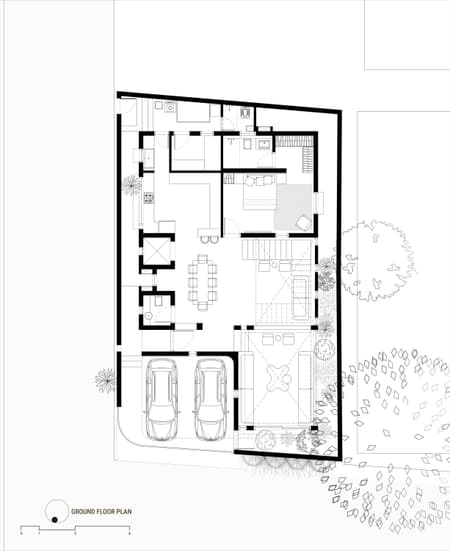
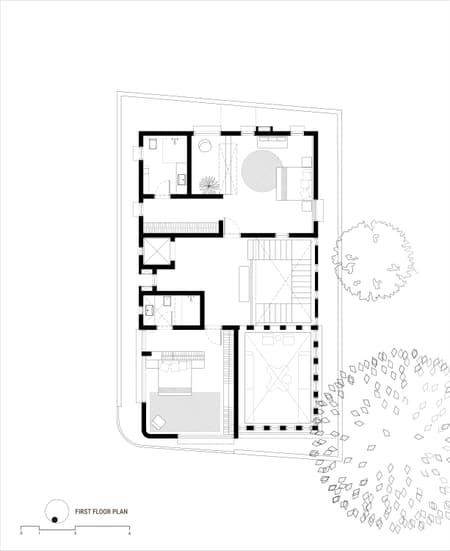
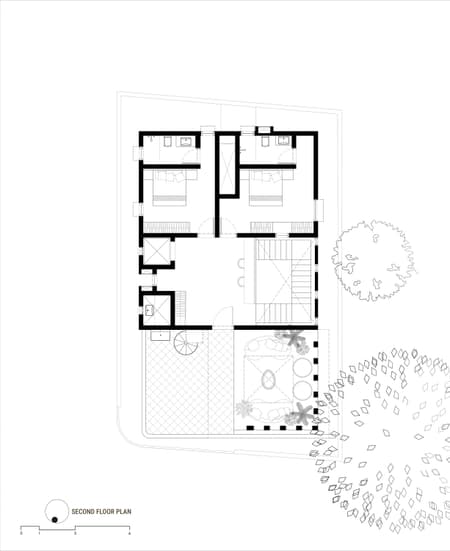
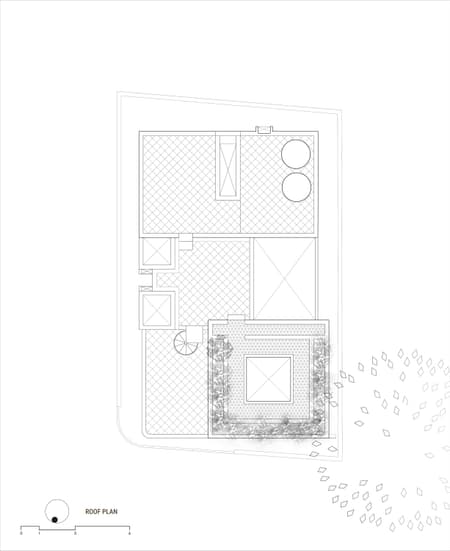
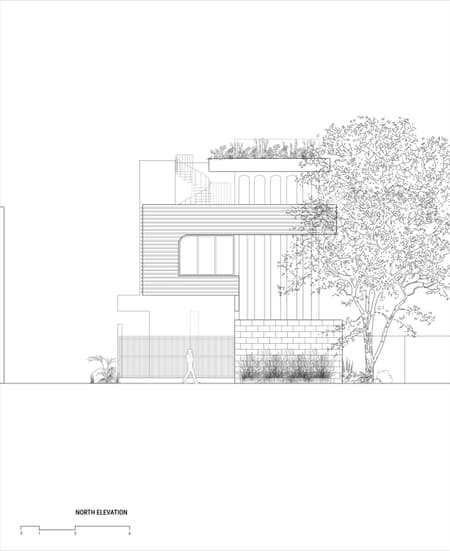
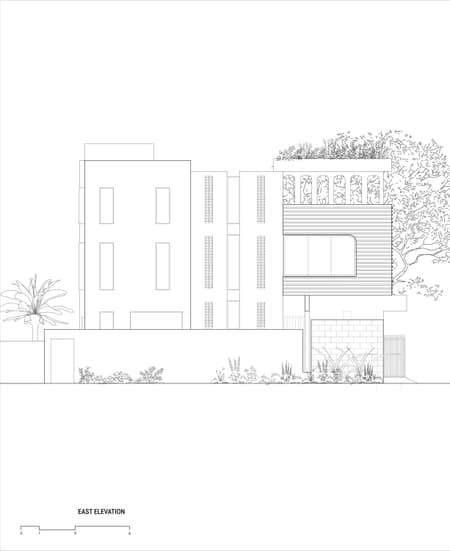
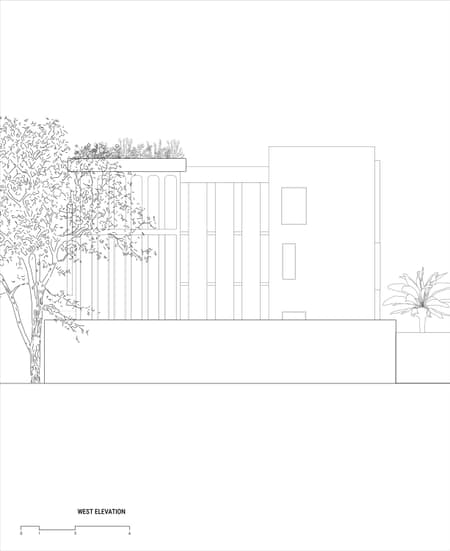
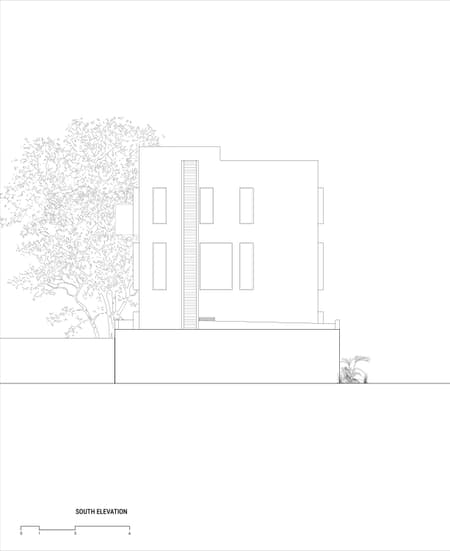
Located in Coimbatore, CTTTT House is set on a corner plot with roads along its north and east edges. Designed within a footprint of 165 sq. m, the project explores how calibrated volumes, light, and spatial sequencing can extend the perception of space and aspiration where the economic middle stretching beyond its own label, nudging at the threshold of affluence . Using conventional reinforced concrete frame with brick infill walls, the house negotiates between practicality and an understated sense of luxury.
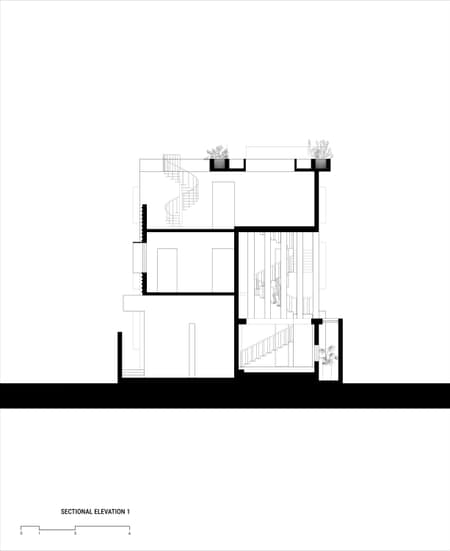
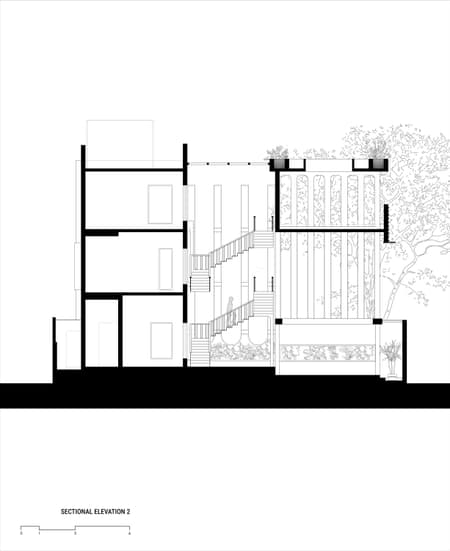
The design is organized as a vertical gradient of volumes, where spatial heights reduce progressively across levels. The ground floor, conceived as the most public and active zone, features a double-height living space that anchors the house. This is complemented by a triple height stairwell that acts as a central organizing element, visually and physically connecting all levels. The first floor accommodates private bedroom spaces, while the second floor is conceived as a more intimate layer, housing two guest bedrooms alongside an open terrace sit out. This semi-covered terrace, envisioned as a reinterpretation of a gazebo in brick and concrete, provides a shaded outdoor extension that offers a transitional threshold between built form and sky.
Natural light plays a critical role in shaping the experience of the house. Full-height fenestrations puncture the built volumes, allowing daylight to penetrate deep into the interiors. Existing trees on the west act as natural filters, softening the harsh post-noon sunlight into a diffused, dappled effect. A skylight above the triple-height stairwell introduces direct overhead light during midday, while passive ventilation strategies help regulate temperatures. The spatial sequencing is defined by a continuous interplay of light and shadow, which shifts throughout the day and across seasons. These variations, combined with the volumetric transitions, create an impression of the house as far more expansive than its footprint suggests
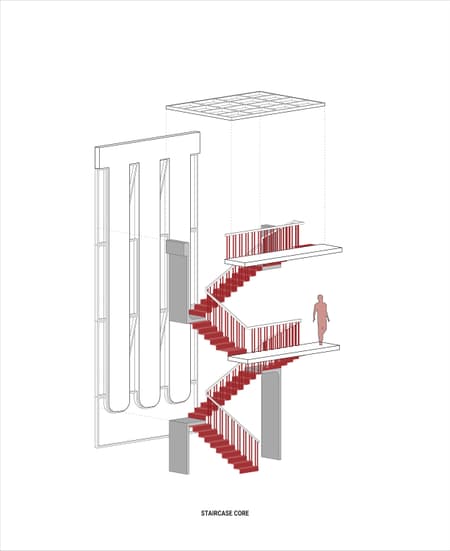
A key architectural feature is the staircase, conceived as a sculptural intervention within the volume. Anchored by two concrete landings shaped as an inverted L geometry, a folded metal plate stair spans between them. Portions of the staircase are suspended from the upper level using the same geometry, executed in steel against a stone wall backdrop, reinforcing a sense of lightness and movement within the central void.
The interiors are designed to foreground the spatial volumes, with furniture, colour, and materiality acting as complementary layers within the composition. The columns and staircase accentuate the verticality. Soft furnishings introduce texture and colour to the barren canvas. The ground floor remains largely inward-looking and private, with landscape within the setbacks at eye level , softening the scale of the built form and framing views toward the treetops and sky. Openings from the bedrooms toward the staircase core and double height living space allow filtered glimpses of the street beyond, while visually connecting all levels of the house and creating a layered relationship between privacy and visual connection
The external expression of the house is developed as a graphic composition of lines and planes. Horizontal bands wrap around volumes, while vertical columns articulate double glazed surfaces. These elements: parallel, intersecting, and overlapping , height create a layered façade that responds to light and shadow, enhancing depth and visual rhythm. Cantilevered planes further accentuate this composition, lending the elevations a dynamic and sculptural quality.
CTTTT House explores how a compact urban footprint can be perceived as spatially expansive volumes, natural light, and layered spatial transitions rather than material excess. The interplay between openness and enclosure reflects contemporary patterns of domesticity, where flexibility, visual connectivity, and retreat are negotiated within a coh esive spatial framework.
T he name CTTTT emerges as a playful abstraction of this graphical language , an interpretation of the repetitive linear elements that define the front elevation and give the house its distinct identity


.jpg?w=450&q=75&dpl=dpl_76Rq87wxQwFvSi96M2iBpo5TN6QL)
.jpg?w=450&q=75&dpl=dpl_76Rq87wxQwFvSi96M2iBpo5TN6QL)
.jpg?w=450&q=75&dpl=dpl_76Rq87wxQwFvSi96M2iBpo5TN6QL)
.jpg?w=450&q=75&dpl=dpl_76Rq87wxQwFvSi96M2iBpo5TN6QL)
.jpg?w=450&q=75&dpl=dpl_76Rq87wxQwFvSi96M2iBpo5TN6QL)
.jpg?w=450&q=75&dpl=dpl_76Rq87wxQwFvSi96M2iBpo5TN6QL)
.jpg?w=450&q=75&dpl=dpl_76Rq87wxQwFvSi96M2iBpo5TN6QL)
.jpg?w=450&q=75&dpl=dpl_76Rq87wxQwFvSi96M2iBpo5TN6QL)
.jpg?w=450&q=75&dpl=dpl_76Rq87wxQwFvSi96M2iBpo5TN6QL)
.jpg?w=450&q=75&dpl=dpl_76Rq87wxQwFvSi96M2iBpo5TN6QL)
.jpg?w=450&q=75&dpl=dpl_76Rq87wxQwFvSi96M2iBpo5TN6QL)
.jpg?w=450&q=75&dpl=dpl_76Rq87wxQwFvSi96M2iBpo5TN6QL)
.jpg?w=450&q=75&dpl=dpl_76Rq87wxQwFvSi96M2iBpo5TN6QL)
.jpg?w=450&q=75&dpl=dpl_76Rq87wxQwFvSi96M2iBpo5TN6QL)
.jpg?w=450&q=75&dpl=dpl_76Rq87wxQwFvSi96M2iBpo5TN6QL)
.jpg?w=450&q=75&dpl=dpl_76Rq87wxQwFvSi96M2iBpo5TN6QL)
.jpg?w=450&q=75&dpl=dpl_76Rq87wxQwFvSi96M2iBpo5TN6QL)
.jpg?w=450&q=75&dpl=dpl_76Rq87wxQwFvSi96M2iBpo5TN6QL)
.jpg?w=450&q=75&dpl=dpl_76Rq87wxQwFvSi96M2iBpo5TN6QL)
.jpg?w=450&q=75&dpl=dpl_76Rq87wxQwFvSi96M2iBpo5TN6QL)
.jpg?w=450&q=75&dpl=dpl_76Rq87wxQwFvSi96M2iBpo5TN6QL)
.jpg?w=450&q=75&dpl=dpl_76Rq87wxQwFvSi96M2iBpo5TN6QL)
.jpg?w=450&q=75&dpl=dpl_76Rq87wxQwFvSi96M2iBpo5TN6QL)
.jpg?w=450&q=75&dpl=dpl_76Rq87wxQwFvSi96M2iBpo5TN6QL)
.jpg?w=450&q=75&dpl=dpl_76Rq87wxQwFvSi96M2iBpo5TN6QL)
.jpg?w=450&q=75&dpl=dpl_76Rq87wxQwFvSi96M2iBpo5TN6QL)
.jpg?w=450&q=75&dpl=dpl_76Rq87wxQwFvSi96M2iBpo5TN6QL)
.jpg?w=450&q=75&dpl=dpl_76Rq87wxQwFvSi96M2iBpo5TN6QL)
.jpg?w=450&q=75&dpl=dpl_76Rq87wxQwFvSi96M2iBpo5TN6QL)