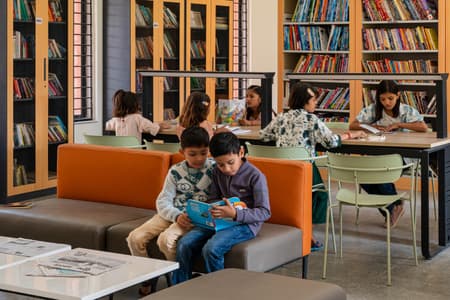
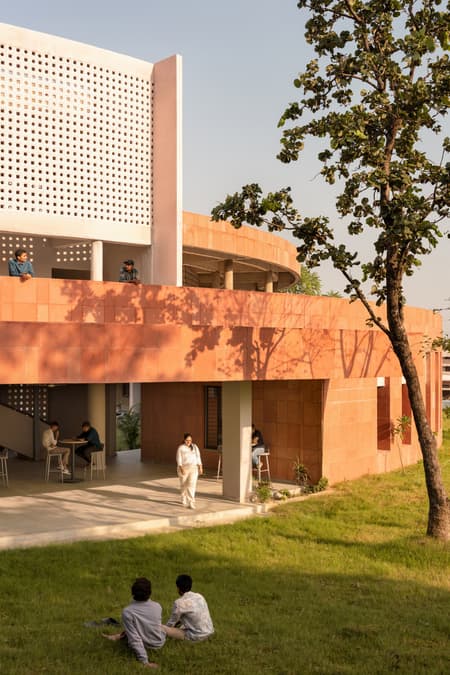
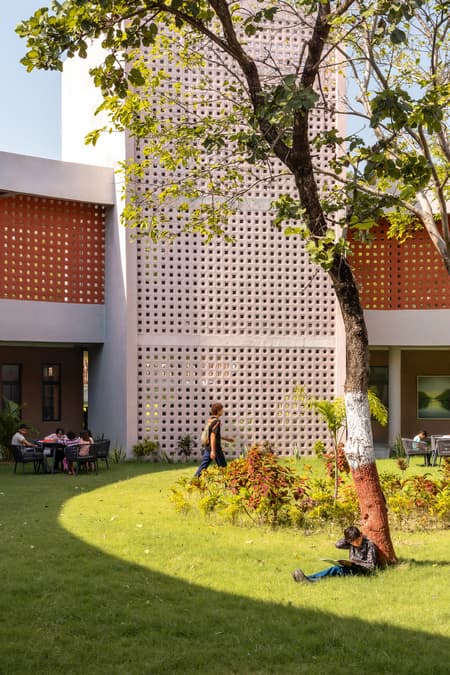
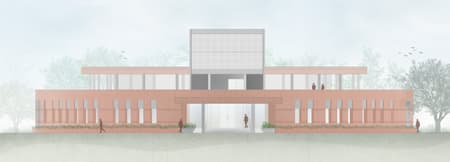
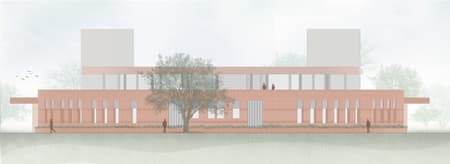
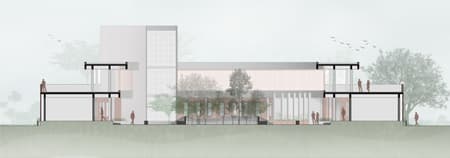
Granthalay is conceived as a civic institution that extends beyond the conventional idea of a library, responding to the acute lack of educational and community infrastructure in the district of Chhatarpur. Commissioned by the Government of Madhya Pradesh, the project aims to serve students, aspirants, senior citizens, and the larger local community, including users from surrounding towns and villages.
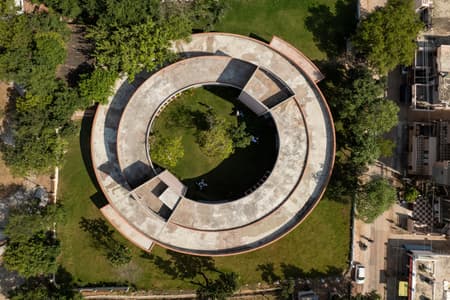
The design is rooted in the guiding framework of People, Place, and Purpose, shaping decisions from spatial planning to material selection. Located on a plot bounded by roads on all four sides and influenced by an adjoining hillock, existing trees, and a proposed public garden, the building responds to both its macro and micro context while asserting a strong civic presence.
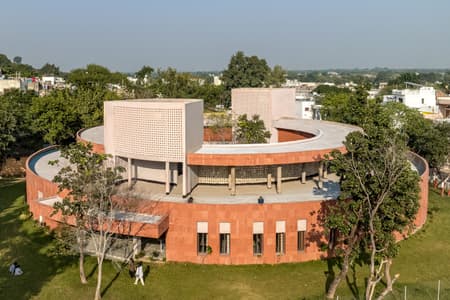
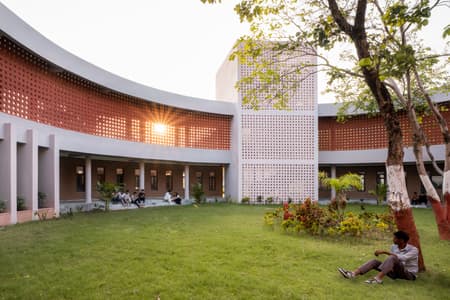
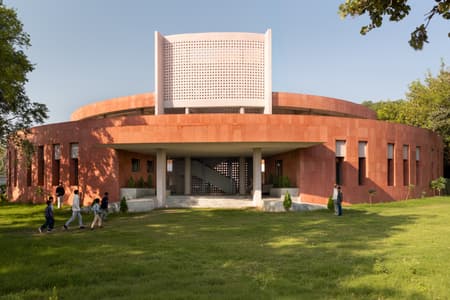
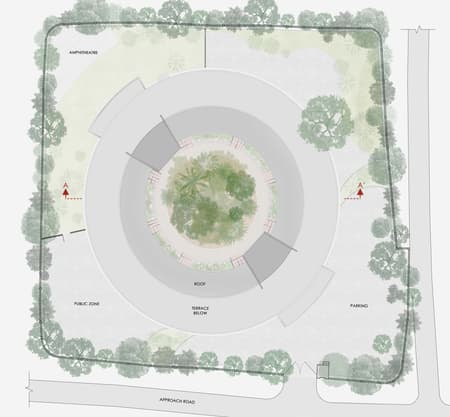
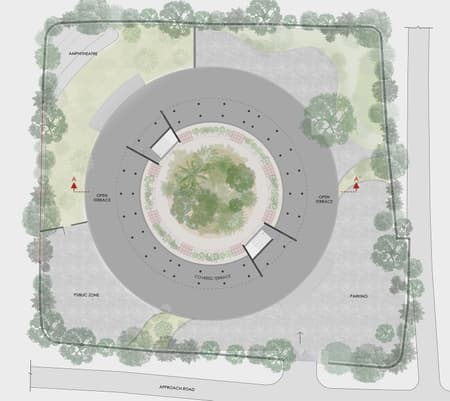
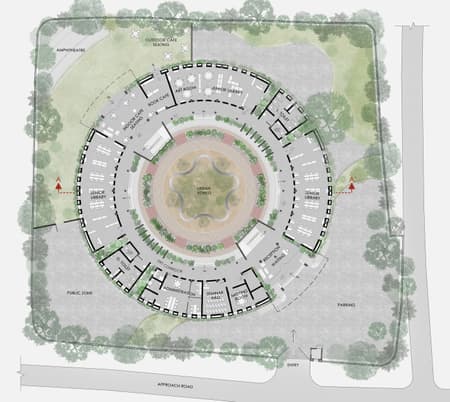
A circular built form anchors the site, emerging as a direct response to the site constraints and access conditions. The geometry enables clear zoning, efficient circulation, and climatic responsiveness, while creating a calm central courtyard that serves as the social and visual heart of the project. Spaces are age-wise segregated, ensuring smooth transitions between junior reading areas, senior study spaces, community zones, and administration. Strategic placement of services and circulation cores allows for seamless user movement and future vertical expansion.
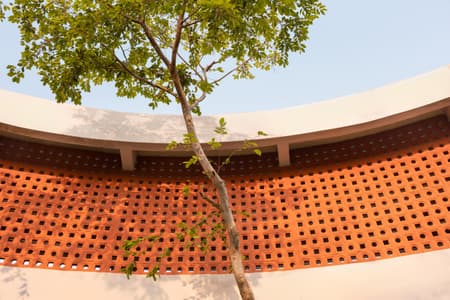
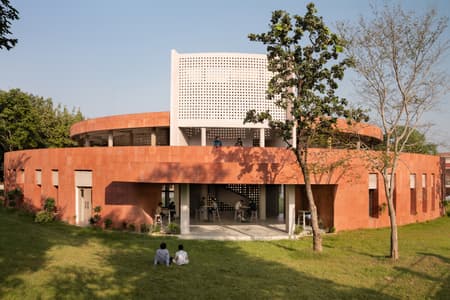
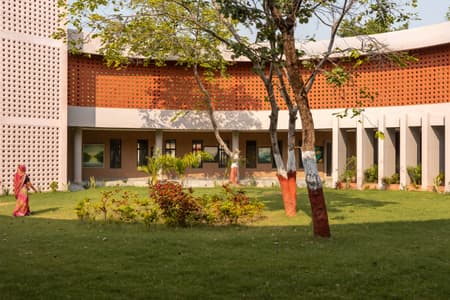
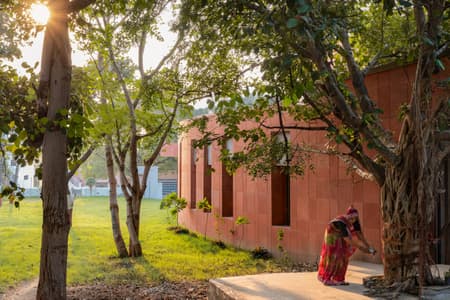
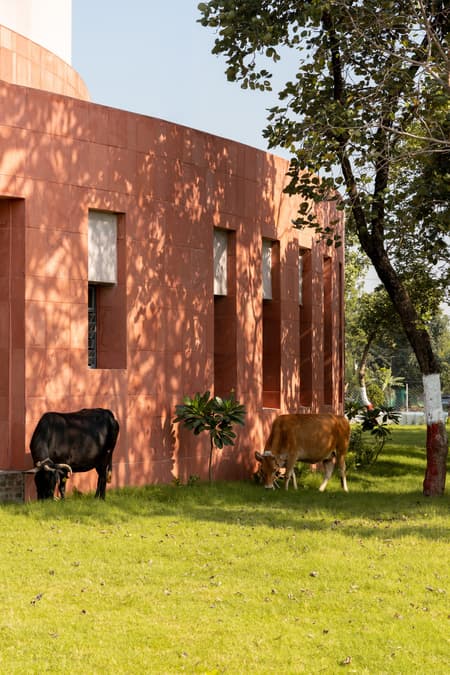
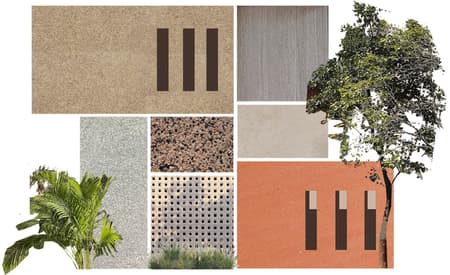
Materiality reinforces the project’s contextual grounding. The use of locally available red sandstone, brick, terracotta blocks, and perforated jali screens lends the building a distinct regional identity while enhancing thermal performance and passive cooling. Semi-open verandas, shaded corridors, and filtered daylight reduce heat gain and promote natural ventilation throughout the year.
Although originally envisioned as a G+1 structure, the project has been executed as a ground-floor building due to budgetary constraints. Structural and service provisions have been incorporated to allow future expansion without compromising the present architectural completeness. Sustainability strategies include rainwater harvesting, optimal orientation for daylight and airflow, and provisions for rooftop solar panels in subsequent phases.
The landscape approach prioritizes the retention of existing trees, particularly a mature banyan that has been integrated as a central natural landmark. Designed to be low-maintenance and locally manageable, the landscape reinforces the building’s connection to its setting.
Executed within the constraints of public-sector processes and local labour, the project demanded high precision, especially given its circular geometry.
Granthalay ultimately emerges as a contextually rooted yet contemporary public building, fostering learning, culture, and community while quietly elevating the civic fabric of Chhatarpur. In its stillness and openness, the building offers something rare—a place where architecture listens, and in listening, gives back.