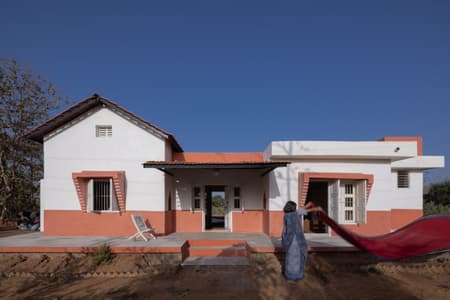
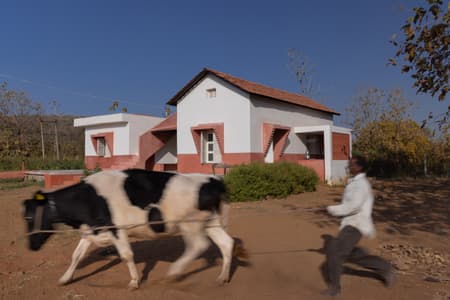
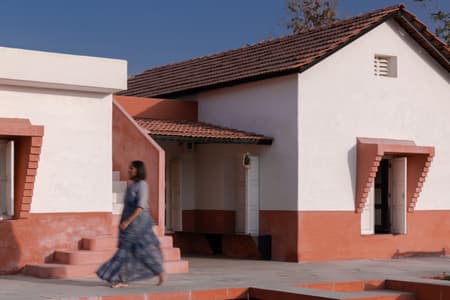
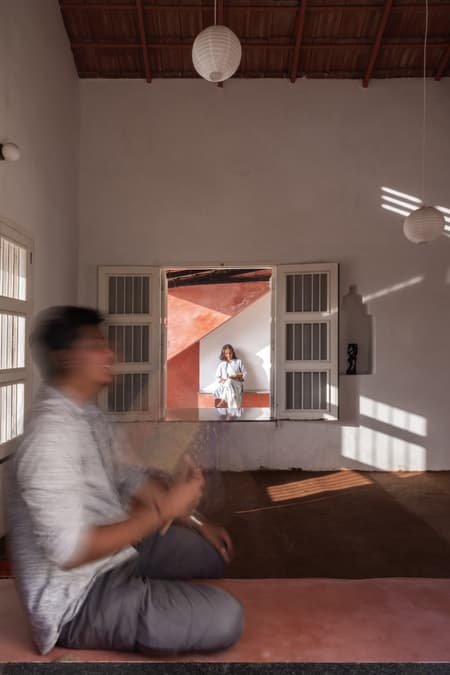
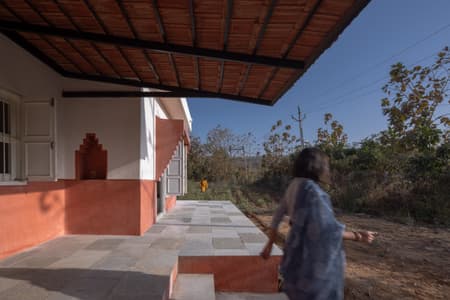
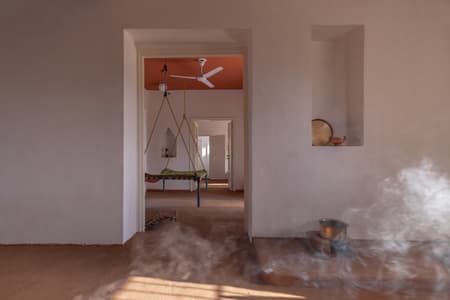
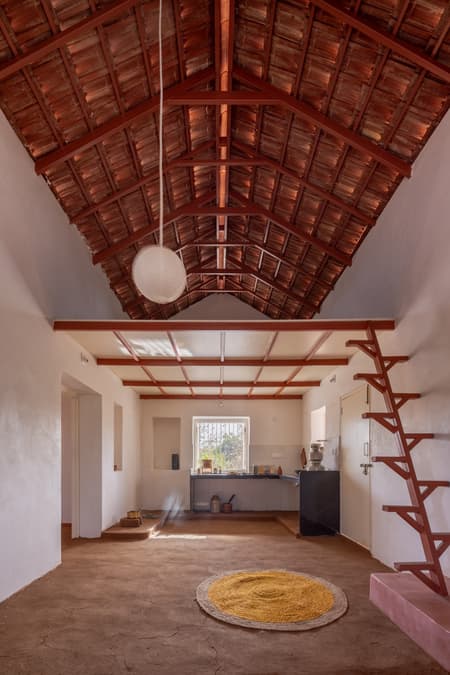
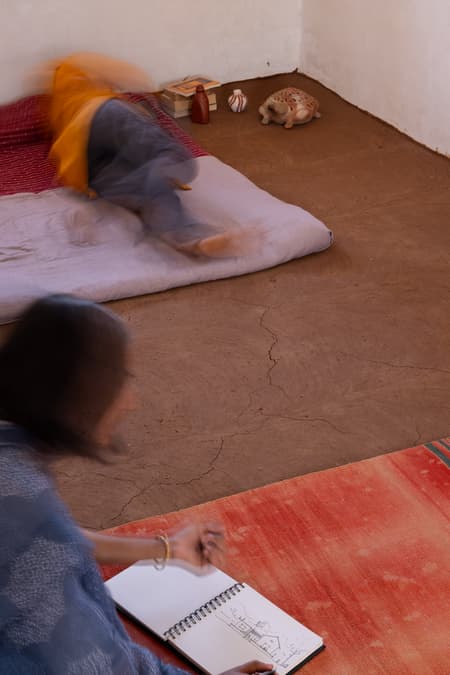
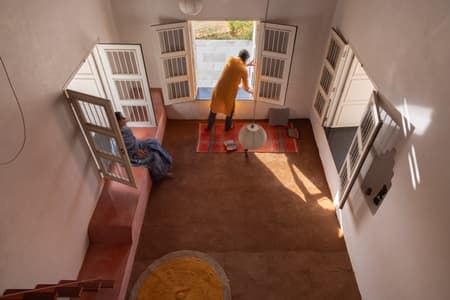
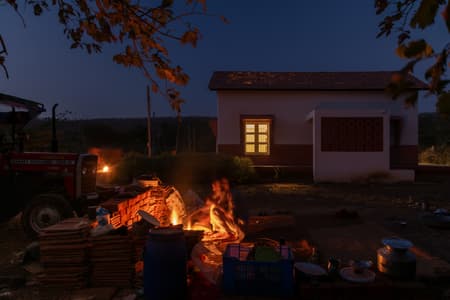
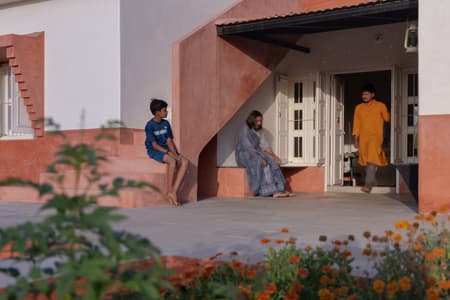
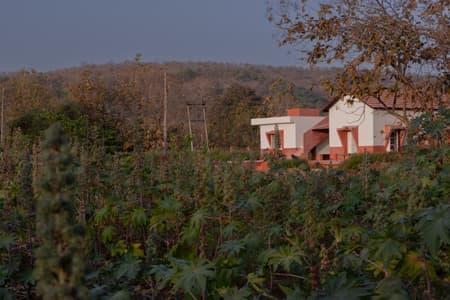
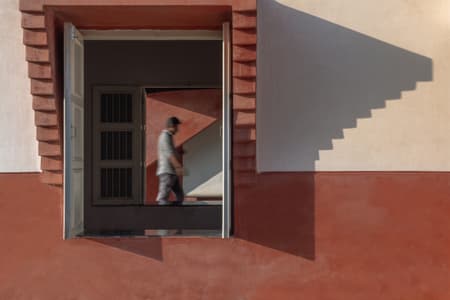
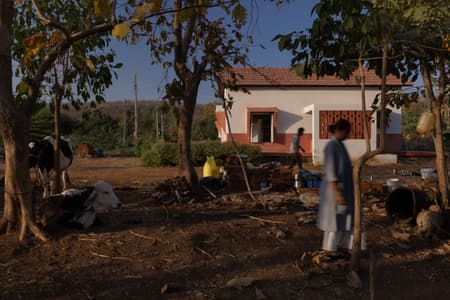
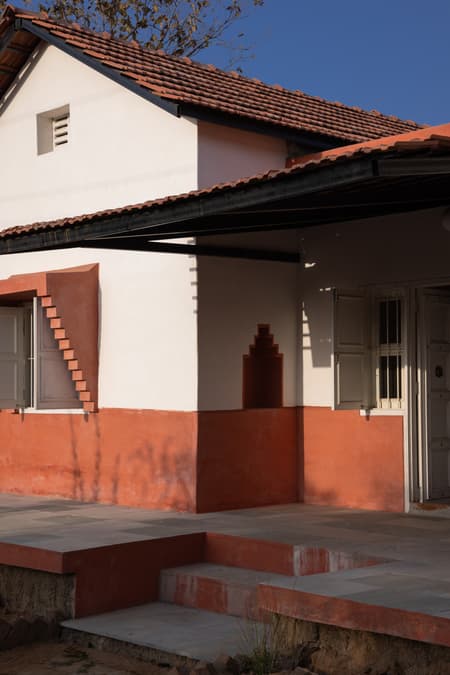
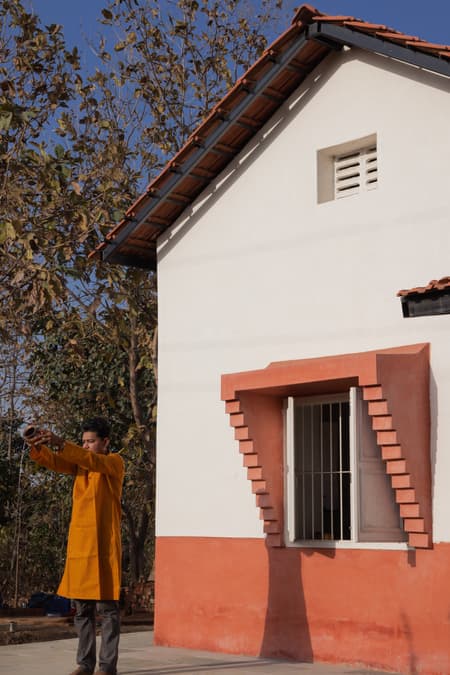
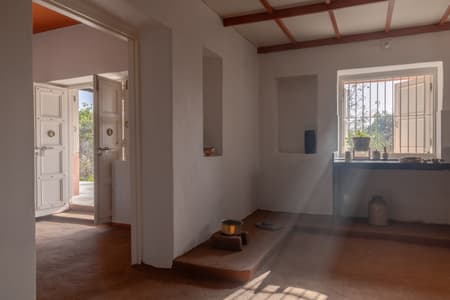
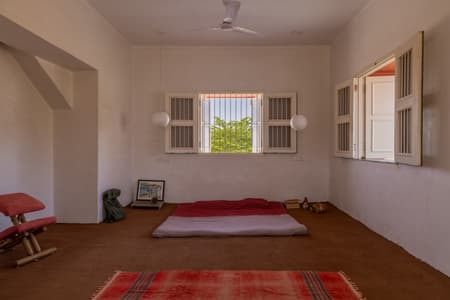
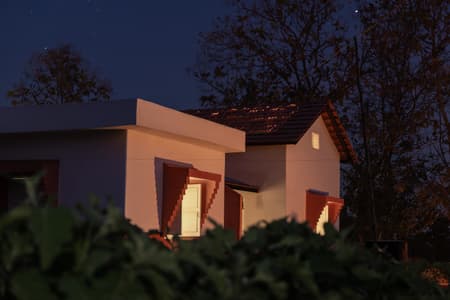
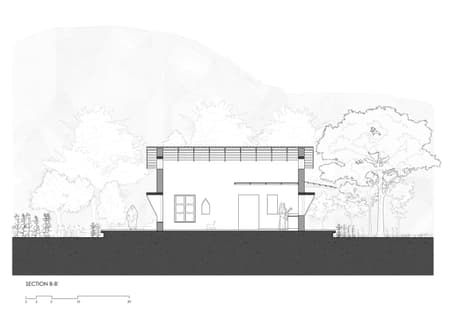
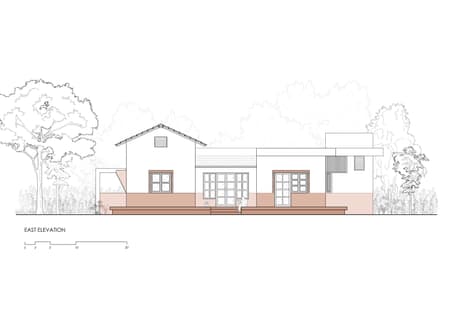
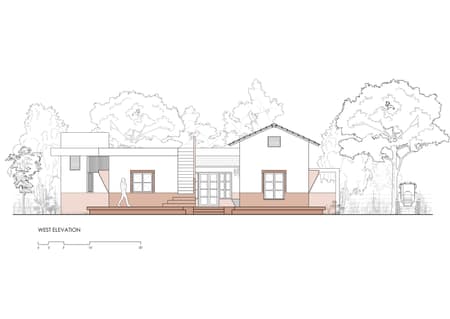
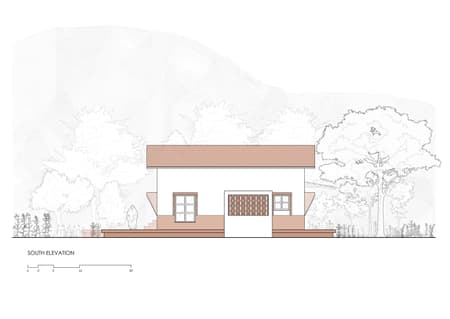
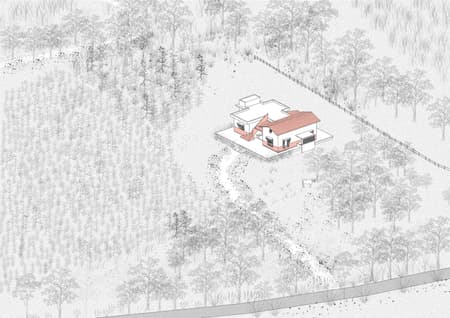
In the quiet village of Khandiya in Gujarat’s Panchmahal district, a new house has been built to belong — to the land, its memory, and a changing future. At first glance, it seems unassuming: sloped tiled roofs, thick lime-plastered walls, earthen floors, and shaded plinths. But this home is more than a rural dwelling — it is a critical architectural proposition. One that challenges the dominant binary of tradition versus progress and instead asks: Might we design in ways that evolve rural architectural logic, rather than abandon it in the name of progress? And what if modular design holds the key to evolving rural housing without severing it from its roots?
This home, designed for a private client, serves as a working prototype for rural housing in the region and is positioned as a replicable model rather than vernacular revival — an attempt to bridge the widening gap between India’s transitioning rural communities and the housing being built for them. The project resists the nostalgia trap. Instead, it reclaims material and spatial intelligence embedded in rural practice and updates it to respond to today’s challenges — economic, environmental, and social.
India’s villages are in flux. Families are smaller, landholding patterns are changing, and aspirations are increasingly shaped by exposure to urban life. And yet, rural housing continues to follow outdated models — either by defaulting to the lowest-cost RCC constructions that ignore climatic and spatial intelligence, or by romanticising vernacular forms in boutique farmhouses detached from daily realities. House of Nostalgia occupies the critical space between these two extremes. It is durable, affordable, and adaptive — a house that is as concerned with permanence as it is with possibility.
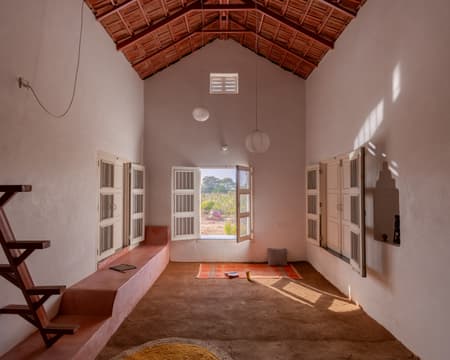
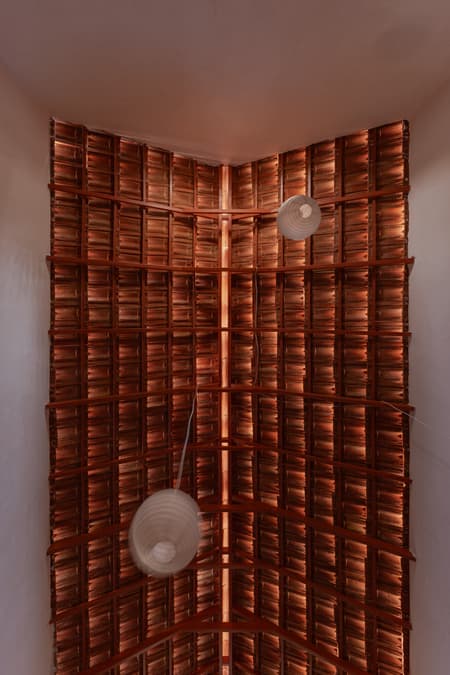
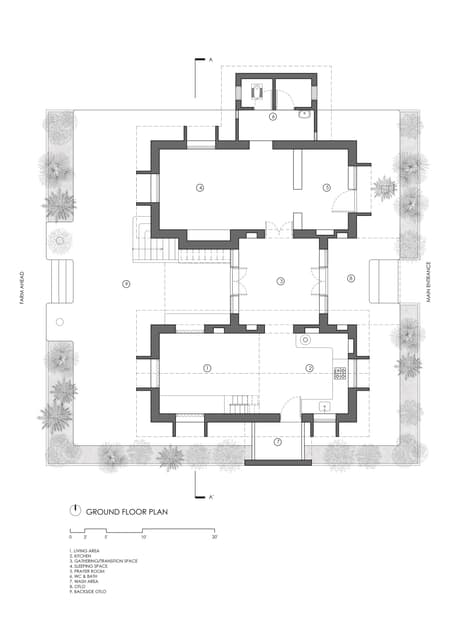
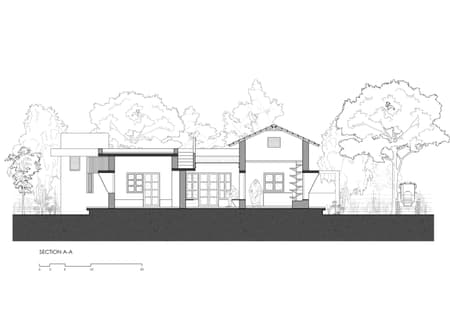
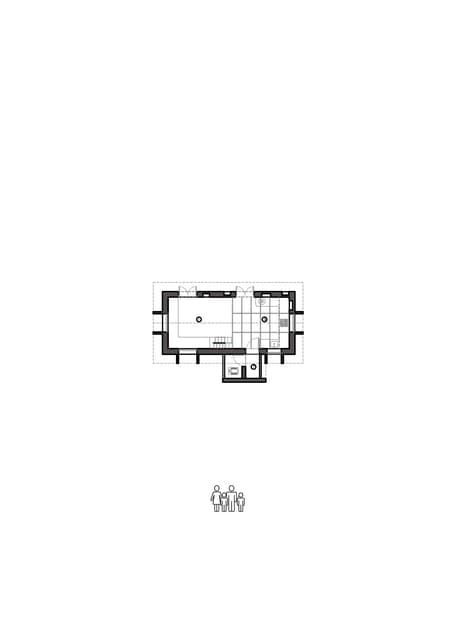
At the heart of its architectural strategy lies modularity. The structure is composed of three interconnected volumes: a sloped Mangalore-tiled unit that includes a mezzanine loft; an RCC slab module that houses the bedroom and pooja room; and a bamboo-reinforced slab unit that accommodates the kitchen and services. Each unit measures approximately 450 sq ft with an ‘H-shaped’ layout and is designed for independent construction, enabling phased completion — a practical necessity in rural contexts where finances, labour, and land often evolve incrementally. This modularity is not a compromise — it is a strategy for flexibility and growth. Built in stages, the house adapts to changing needs without losing spatial clarity, offering a dignified alternative to the fragmented expansions common in rural areas.
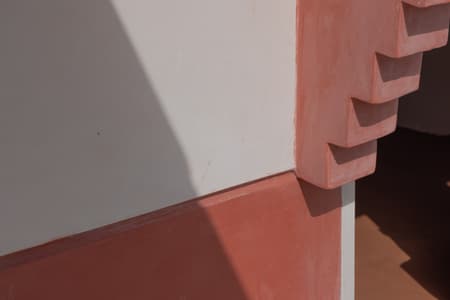
Material choices reinforce this logic of continuity. The project sourced brick, stone, lime, bamboo, and timber from the immediate context. These materials are not selected for sentimentality or craft tokenism; they are chosen for performance, economy, and environmental logic. Lime enables breathability and passive cooling. Brick and stone offer density and low thermal conductivity. Bamboo, used in slab construction, is lightweight, cost-effective, and locally abundant. These decisions restore agency to rural material culture — not as a stylistic gesture, but as a construction strategy that reduces embodied energy, increases durability, and requires minimal maintenance.
In doing so, House of Nostalgia critiques a troubling trend in Indian rural construction: the default replication of urban RCC models, often funded by remittances or government schemes, which flatten regional differences and ignore climatic nuance. These concrete homes are seen as symbols of progress but perform poorly in thermal comfort, spatial coherence, and evolving needs. In contrast, this house proposes regional modernity — an architecture that grows out of its geography and reflects local aesthetics, without being a replica of the past.
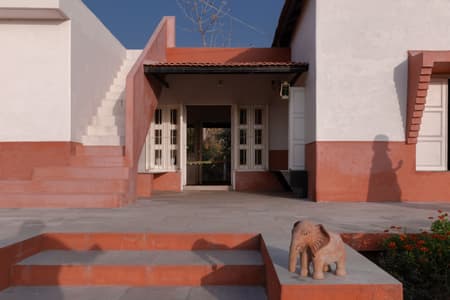
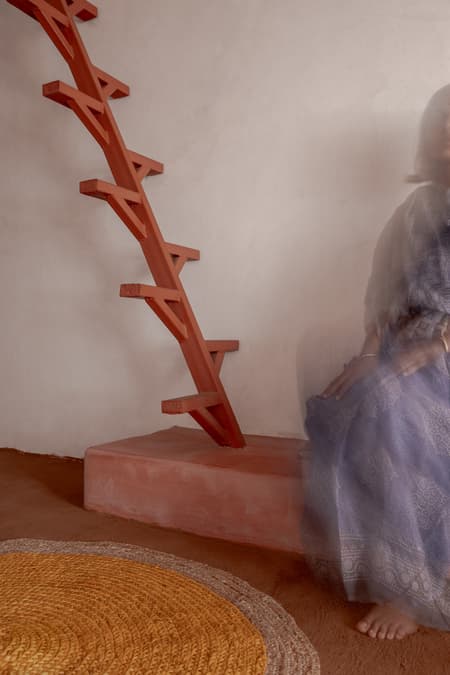
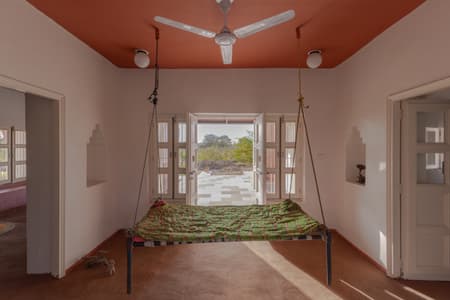
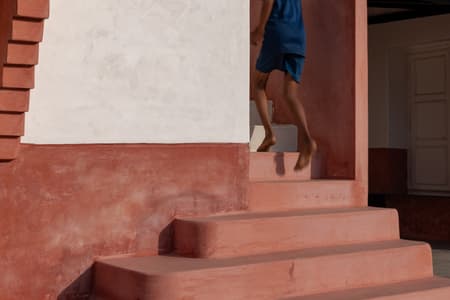
Its architectural language — thick walls, built-in niches, transitional thresholds, verandahs, and a central courtyard — is drawn from generations of rural logic. These elements regulate heat, organise space, support social interactions, and extend domestic life into the outdoors. The extended plinth becomes a semi-public space; the mezzanine offers a playful perch; and the semi-open connector between modules becomes both passage and pause. Passive cooling is not layered on — it is embedded into form. At its core, the house responds to shifting rural lives — grounded yet mobile, traditional yet evolving. It offers a permanent, adaptable, and low-cost solution that grows with its occupants while retaining architectural depth.
In this sense, House of Nostalgia is not a building, but a framework. A system of thinking and making that can be transferred across rural India’s diverse geographies. It is not about exporting form, but replicating the process — using local materials, designing for growth, and reinforcing regional identity through quiet, functional design. It asks us to rethink how we define progress in the built environment, and to look at rural housing not as a site of deficiency, but as a potential site of innovation. It urges us to treat the rural not as the past, but as fertile ground for the future of sustainable living.
House of Nostalgia offers a model of architectural continuity. More than a single home, it offers a replicable method — designed to carry forward what still works. It teaches us that building with old wisdom is a way forward. And in doing so, it offers a compelling proposition: that the future of rural housing lies not in looking outward, but in digging deeper — into place, into memory, and into modular methods that can hold both.