Philippe Auguste Middle School, Gonesse (95)
Construction of a new school cafeteria and conversion of the former dining hall into classrooms
Building the places where our children are educated is a demanding task. Too often, we find that these spaces suffer from obsolescence — both functional and symbolic.
Indeed, school architecture in France is strongly marked by two major eras: on the one hand, the 19th century, with the “Jules Ferry” school model; on the other, the post-war years, with the “Pailleron” model.
And while we continue to build new schools today, many are being renovated, extended, or transformed from these earlier models.
The Philippe Auguste Middle School is no exception. It belongs to the post-war period — the era of zoning, edges, and boundless spaces, where emptiness and fullness have lost their connection.
In this extension project, urbanity is not sought through a constructed, architectural order, but rather through a sensitive atmosphere — one that could be described as “physiological,” as it is deeply connected to a living environment.
Located in the heart of a district undergoing renewal, the Philippe Auguste Middle School was built in the late 1970s and now shows many signs of deterioration, both technical and functional.
The Val-d’Oise Department, the client, has launched an extensive restructuring and extension program that aims to:
– Convert the former dining hall into classrooms ; – Create an extension to accommodate new spaces — such as the new cafeteria and changing rooms for students — while organizing and clarifying access; – Enhance the school’s image through a contemporary and engaging architectural approach; – Address the major constraint of carrying out construction work on an occupied site.
The project is part of a broader effort to requalify both built and landscaped spaces, restoring coherence and legibility to the campus layout and to students’ daily experience, while building upon the existing structures.
To accommodate the growing number of students, the project includes the creation of a new cafeteria housed in an independent building. This layout frees up space in the main building, which will be converted into additional teaching rooms.
Relocating the cafeteria outside the main academic building offers a unique opportunity to imagine new spatial sequences. The project envisions this program as a moment of pause — a “parenthesis” in everyone’s day.
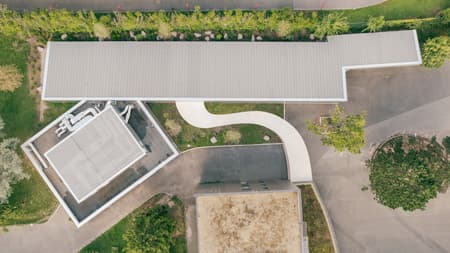
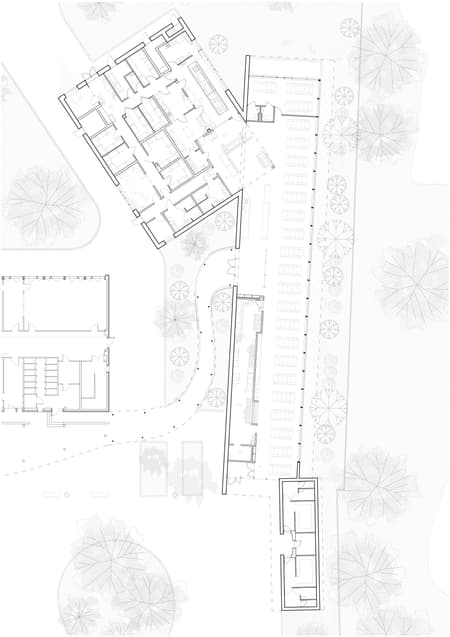
The site’s geometry is highly constrained. Rather than attempting to give more depth to the cafeteria volume, inserted between the schoolyard and the property boundary, the design choice was to emphasize its elongated form.
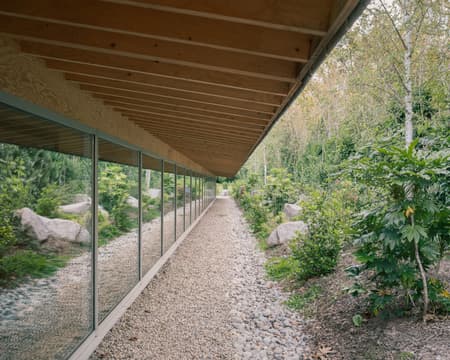
Oriented toward the edge of the site, the dining hall creates a landscape withdrawn from the surrounding activity — a calm, distinct atmosphere.
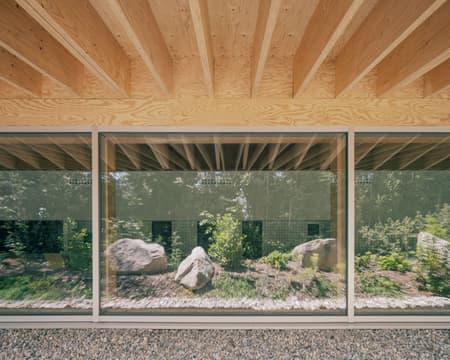
Conceived as a quiet, open, and welcoming space, the cafeteria deliberately distinguishes itself from the rest of the school. It takes a counterpoint to the orthogonality characteristic of 1970s architecture, expressing a subtle shift in volumes and asserting a long, linear dining space that opens onto dense vegetation filtering the light.
From within the school grounds, and particularly along the students’ circulation routes, the new extension appears almost opaque: only an office and the laundry room open onto the courtyard. The volumes, unified by a slightly reflective aluminum cladding and a standing seam zinc-effect steel roof, form a coherent composition made up of three interlocking volumes.
The kitchen, occupying a square footprint of 340 m², is positioned along the existing service road. It benefits from a direct delivery access via the logistics entrance, connected to the existing service yard that allows truck turnaround. This new facility improves the students’ daily environment by enabling on-site meal preparation — unlike the former cafeteria, which lacked its own kitchen.
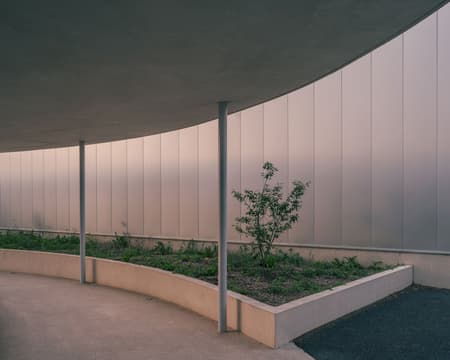
Access to the dining hall is through a waiting area sheltered beneath a 32 m-long canopy. Its organic form follows the path of the walkway and integrates seamlessly into the new landscaped design, offering users a pleasant space with built-in masonry seating. Made of cast-in-place reinforced concrete, the canopy rests on slender metal columns that lend it a sense of visual lightness.
Upon entering the building, students first pass the restrooms before reaching the self-service line.
The dining hall stretches 55 m long and 10 m wide, based on a 2.40 m structural grid. Generously glazed on the eastern façade, it opens onto a dense garden forming a 5 m-wide planted buffer between the building and the property boundary. At the north-eastern end, the teachers’ lounge enjoys a more distant view of the landscaped surroundings.
A dishwashing area integrated within the dining hall allows trays to be dropped off directly near the exit to the schoolyard, avoiding any crossing of incoming and outgoing flows.
Two changing rooms, each 120 m², are dedicated to students’ sports activities. Located near the gymnasium and adjoining the dining hall, the volume accompanies the exit from the cafeteria while providing a visual and acoustic transition between the calm of the dining hall garden and the liveliness of the playground.
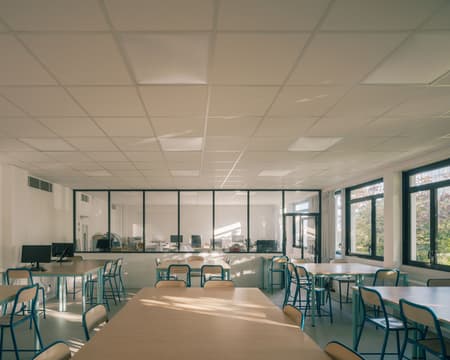
Located on the first floor of the original northern building that houses classrooms, the former cafeteria — vacated following the extension — is now being converted into new teaching spaces. The layout follows the existing structural grid and principles, with a central “service” band (storage, vertical circulation, etc.) and classrooms on either side. This double circulation system ensures fluid movement and prevents any rooms from becoming dead ends.
The intervention is conceived as a succession of sequences in which architecture and landscape intertwine to enhance the overall quality of the spaces. Each functional program is accompanied by a carefully designed and articulated outdoor area, creating a series of spatial moments that structure and enrich the students’ daily experience.
The project introduces a covered walkway that weaves and undulates through a garden, inviting views of the landscape on both sides. Students wait in the shelter of the canopy, surrounded by a calm, planted atmosphere. It serves as a transitional space between the liveliness of the courtyard and the more contemplative moment of the meal.
The canopy is not merely an architectural element connecting the main covered playground and the schoolyard; it marks the first step in the entry sequence leading to the extension.
It is directly integrated with the landscaped design, which is slightly elevated to create masonry seating areas.
Once inside the building, the sequence unfolds through handwashing, followed by a calm waiting area before reaching the self-service line.
The dining hall is a long, linear space that opens onto an intimate, secluded garden. Completely detached from the rest of the school, it offers a distinct moment apart. The slenderness of the building allows for the maximum number of tables to face the garden.
Extending from the students’ dining area, the teachers’ lounge occupies the north-eastern tip of the dining hall. Set apart from the courtyard, it benefits from a quiet atmosphere, away from the flow of students.
Set back from the playground in a separate volume from the dining hall, the kitchen opens onto a north-facing patio, created by the offset between the two buildings, offering staff a pleasant view.
The exit, located at the southern end of the dining hall, opens directly onto the courtyard.
A true guiding thread of the project, the landscape goes beyond mere accompaniment, creating a succession of planted atmospheres that accompany the students throughout their lunch experience.
The architecture weaves through a series of small landscapes to offer gentle, nuanced atmospheres:
- the dense vegetated strip to the east of the dining hall, - the more open landscape overlooking the teachers’ dining area, - and the landscaped intervention along the entrance sequence.
Each part of the cafeteria thus engages in dialogue with its own distinctive vegetal environment.
1. The landscaping around the dining hall consists of adding topsoil and gravel, along with rustic stone outcrops, complemented by standard trees and multi-stemmed specimens to create a sense of density.
2. The teachers’ dining area features a composition of shrubs combined with a mineral zone.
3. The entrance sequence is landscaped with low perennial plants set within a raised masonry planter.
In the kitchen, the food preparation counter opens onto the green spaces, providing a pleasant view of the garden. These views benefit the staff, offering a calming environment that helps enhance their working comfort.
Two changing rooms are provided for the students, complemented by a storage room accessible from the courtyard. The exposed wood echoes that of the dining hall ceiling, while an orange hue is featured on the tiles and seating.
The intervention in the existing building — the former cafeteria converted into classrooms — involved gutting the space, reorganizing the interior partitions, and replacing the suspended ceilings and furniture.