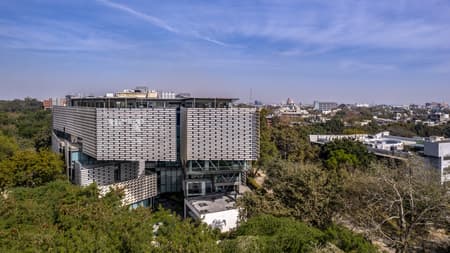
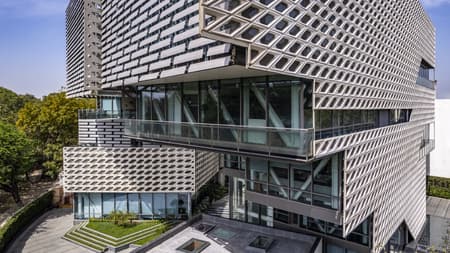
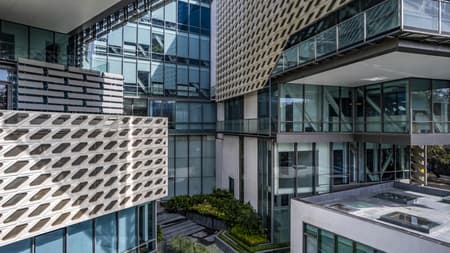
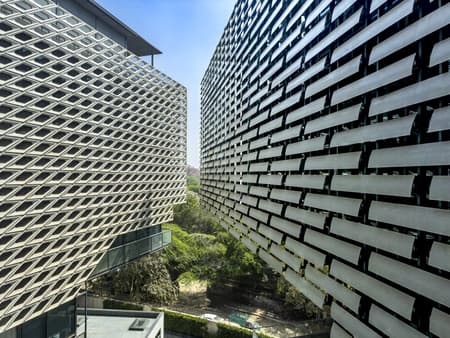
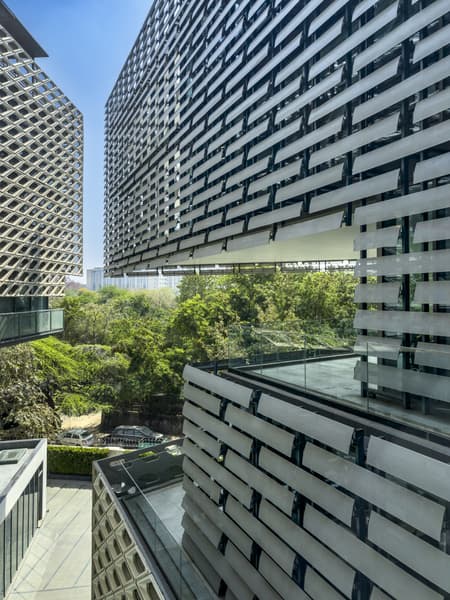
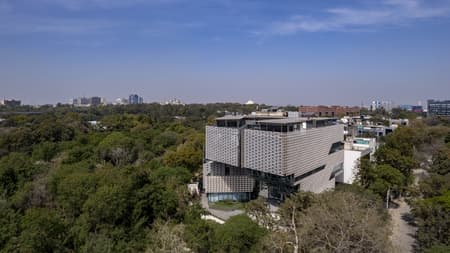
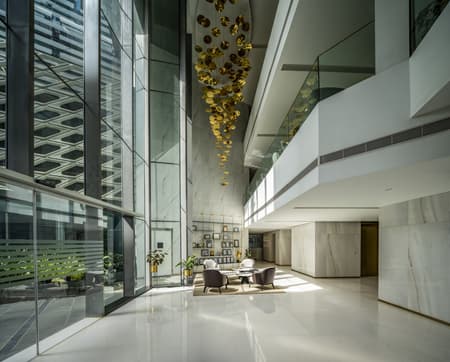
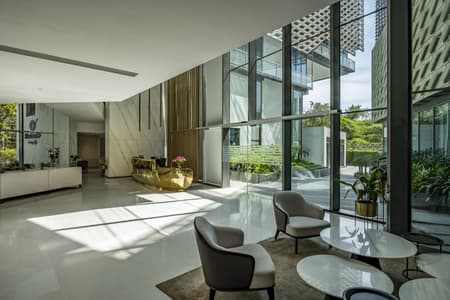
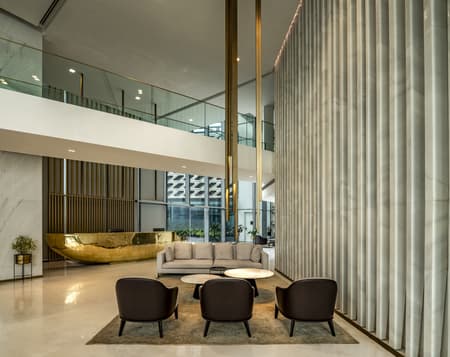
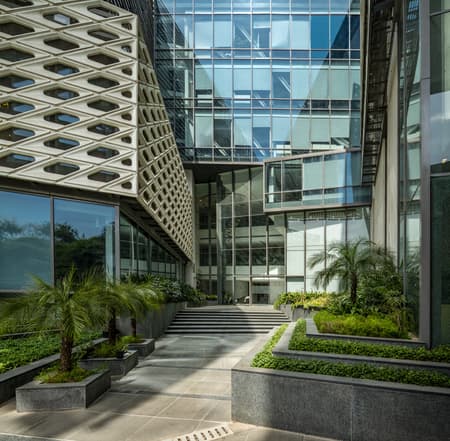
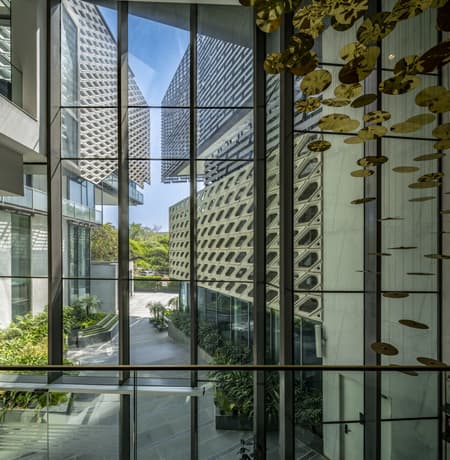
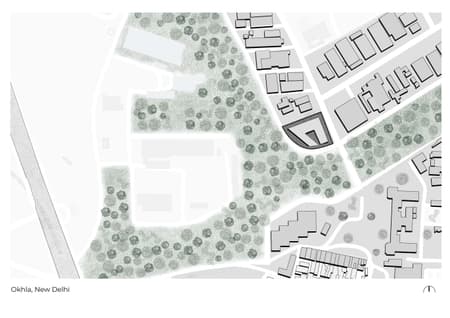
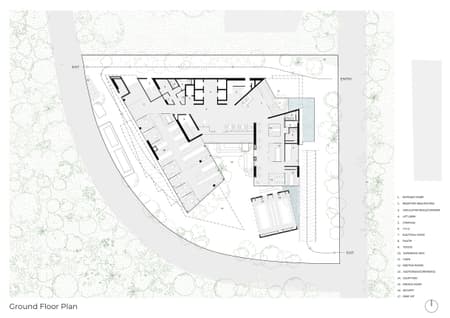
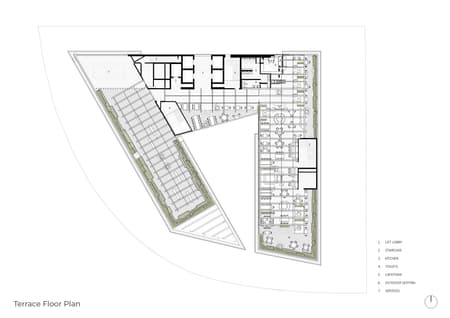
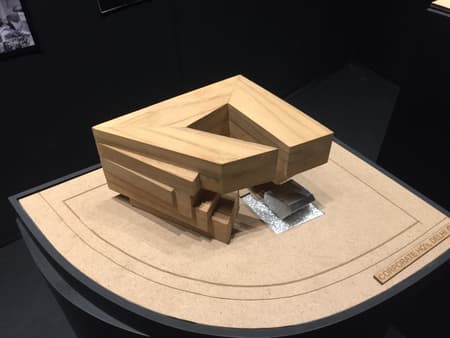
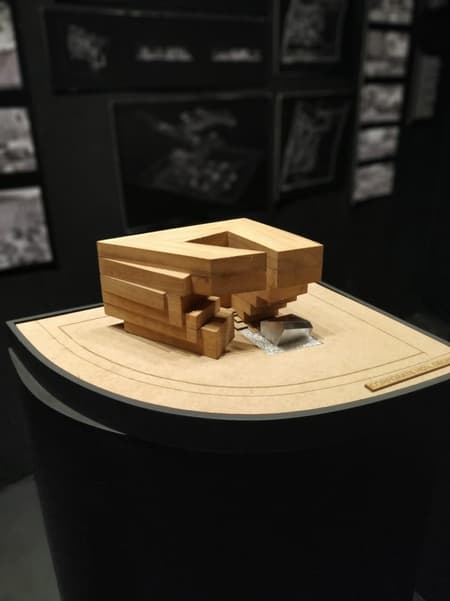
The site for this project is located in a former industrial zone in Delhi. The quadrant shaped plot is flanked by long green spaces densely populated by trees. Out first thought when we visited the site was to consider the possibility of voiding the street level spaces to allow ‘Nature’ in. Another recurring aspect of our current work is the subversion of the growing imbalance between the public and private domain and the desire to activate the ground for shared community space and increased urban porosity.
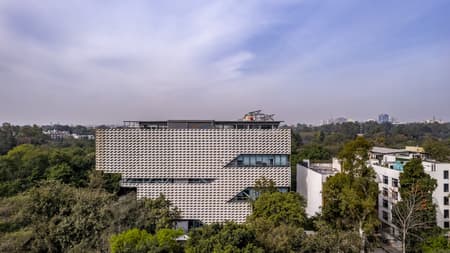
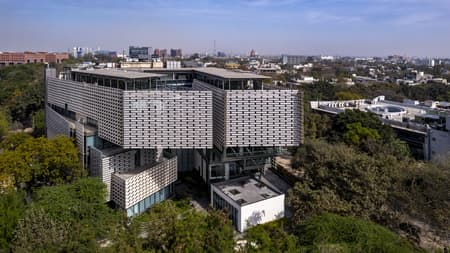
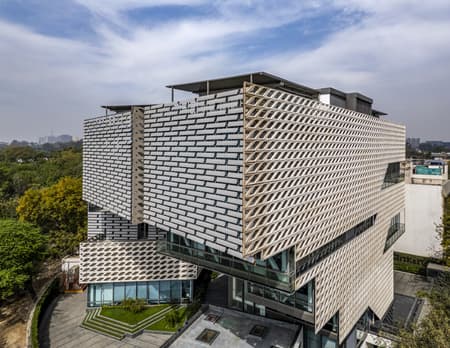
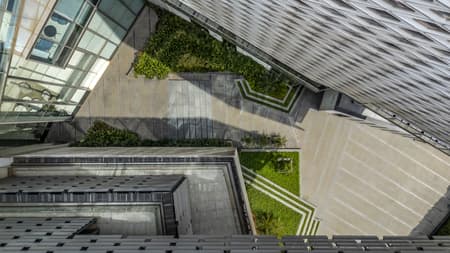
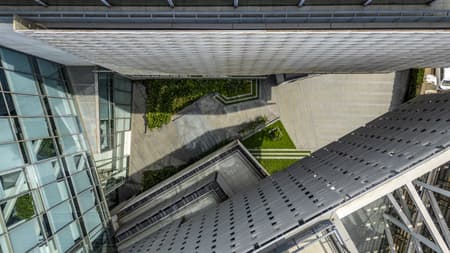
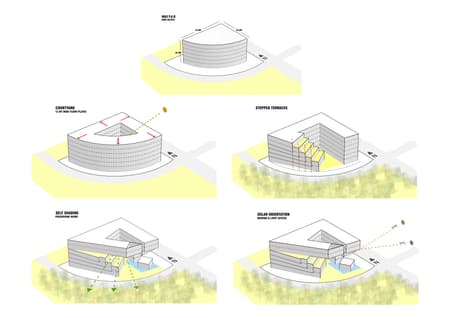
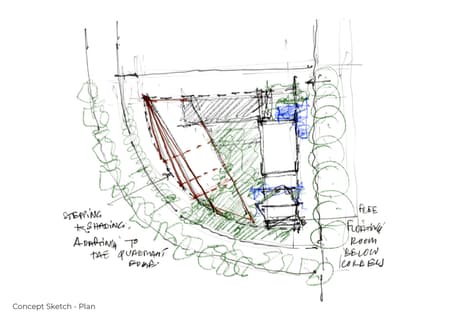
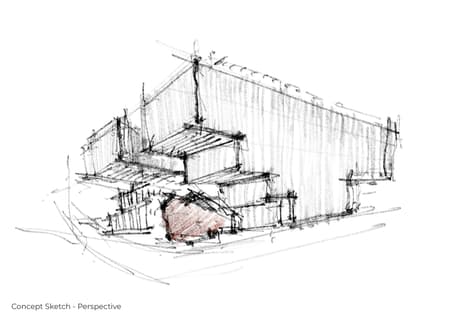
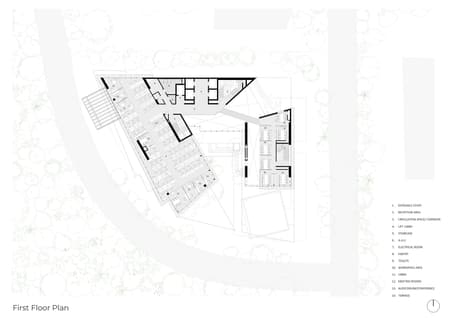
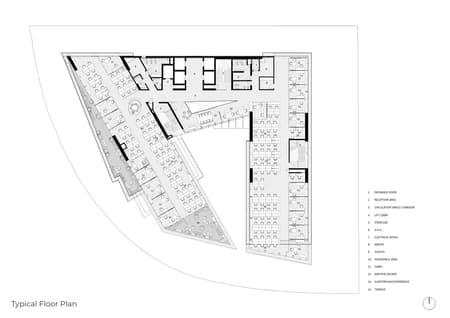
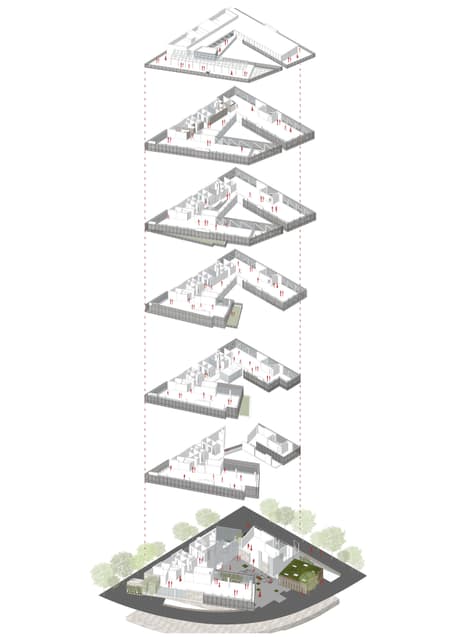
The architectural proposal uses the extruded quadrant as its starting point from where a series of excavations and shifts based on orientation, program, courtyard shading, view angles to the trees beyond, and accessibility are performed, resulting in a building that mutates to bind its defined internal program with the courtyard and the trees beyond through a series of shaded terraces.
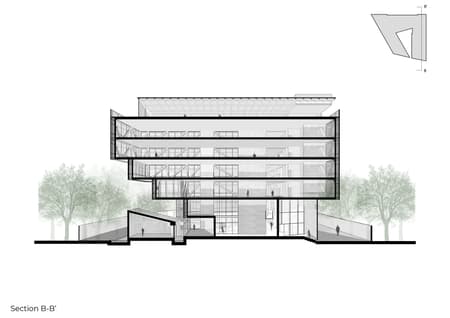
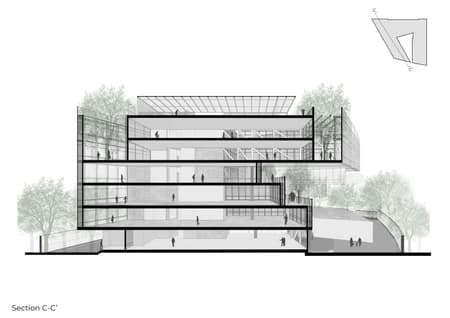
The building cantilevers and corbels preserve the outdoor views for all the working spaces while shading the community spaces at the street level, where the building essentially opens up to the city park and mediates the relationship between the public and private domains through the courtyard.
The use of steel in this building is optimised at individual locations as per the architectural design.One way column free PT slab system, steel composite frames with RCC columns and steel beams was conceptualized at an early design stage. Concrete performs well on shorter spans and heavy axial loads. Steel performs well on longer spans and lighter loads. Cantilever portions have been selected to be on steel whilst controlling performance of deflections and vibrations.
The building consists of two wings featuring large cantilevers and corbelling techniques that are both addressed seperately. Wing A is primarily an RCC structure with its top two levels consisting of a large two level cantilevered truss with an effective span of 25 Mts (16 Mts. + 9Mt triangular terrace)
For Wing B (ie the corbelled form) the most effective structural frame was determined to be a steel frame which allows great structural efficiency. It was analysed in its entirety as a separate model and its frame members tuned to reasonable size.
A detalied analysis led to effecient design of the trusses where each element of the trusses (verticals, beams and diagonals) were optimized for its size as per the transfer of loads that leads to reduction in the total tonnage of steel.
The concept emerged from a desire to rethink the relationship between architecture, landscape, and the evolving nature of work. The once industrial site, now flanked by dense green strips—offered a rare urban condition where nature could lead the design. Rather than dominate the ground, we allow the park to flow inward and make the base a shaded threshold. The form was sculpted through carving, corbelling, and shifting—guided by light, views, shading, program, and access. The courtyard became central to both spatial flow and environmental performance, resulting in a building that mutates to bind its defined internal program with the courtyard and the trees beyond through a series of shaded terraces.
The quadrant shaped plot is flanked by long green spaces densely populated by trees. Our first thought when we visited the site was to consider the possibility of voiding the street level spaces to allow ‘Nature’ in. The building cantilevers and corbels preserve the outdoor views for all the working spaces while shading the community spaces at the street level, where the building essentially opens up to the city park and mediates the relationship between the public and private domains through the courtyards.
The building’s rotated and carved mass responds to solar orientation, minimizing heat gain and maximizing daylight. Deep cantilevers and overhangs shade the facade, reducing cooling loads. Courtyards and terraces encourage natural cross-ventilation, enhancing comfort without mechanical intervention. Materials are locally sourced, including indigenous stone and recycled metals, chosen for durability and low embodied energy. The compact footprint preserves permeable ground for groundwater recharge, supported by rainwater harvesting and drip irrigation. HVAC systems are zoned and demand-responsive to optimize energy use. Through careful design, the building has successfully achieved LEED Gold Certification and stands as a model for ecologically sensitive corporate design.
The Mankind Headquarters reimagines corporate architecture in Delhi as a site of convergence between people, ecology, and urban life. Set in a former industrial district, the quadrant-shaped plot is flanked by green corridors, which inspired the design. Instead of occupying the ground, the building voids it—letting nature and community life flow in. This subversion of typical corporate form creates a porous, breathing structure that connects rather than isolates. The mass is shaped by corbelling, carving, and shifting—moves that enhance daylight, views, shading, and ventilation. Greenspaces foster comfort and reduce energy use. At street level, the building engages openly with the city. It lifts into a shaded plinth that welcomes pedestrians and fosters community interaction. Informal gathering spaces and garden edges animate this zone, dissolving traditional boundaries of corporate campuses and transforming the project into a shared urban experience. Its strength lies in its simultaneous engagement with climate, context, and culture—offering a workplace that feels more like a living landscape than a closed structure; where workspaces open to the outdoors at every level, offering equitable views and stronger connections with nature. The defining characteristic is its generosity—of space, shade, and openness inviting participation, reflection, and connection.
We wanted a building that reflects our values—open, collaborative, and connected to both people and the environment. This headquarters goes beyond function; it fosters dialogue, transparency, and well-being. The experience of working here is shaped not just by the interiors but by how seamlessly the building engages with nature and the city around it.The Mankind Headquarters redefines the corporate workplace as an evolving dialogue between architecture, landscape, and community. Located on a former industrial site in Delhi and framed by dense green corridors, the building invites nature inward by lifting itself above the ground to create a shaded, open plinth that connects directly with the surrounding park. The massing emerges from carving, corbelling, and shifting—strategies that respond to light, orientation, and program while fostering a seamless transition between inside and out.
At its heart lies a courtyard that binds internal workspaces with terraces and trees beyond, offering visual and climatic continuity across levels. The structure’s ecological intent is evident in its deep overhangs, courtyards, and shaded terraces that reduce heat gain, maximize daylight, and enable natural ventilation. Locally sourced materials and water-sensitive landscaping reinforce its sustainable ethos.
Awarded LEED Gold Certification, the building becomes a model of environmentally responsive corporate architecture—an open, collaborative space where nature and work coexist. More than an office, it is a landscape for exchange, reflection, and connection, embodying the client’s vision of transparency and well-being.
The concept emerged from a desire to rethink the relationship between architecture, landscape, and the evolving nature of work. The once industrial site, now flanked by dense green strips—offered a rare urban condition where nature could lead the design. Rather than dominate the ground, we allow the park to flow inward and make the base a shaded threshold. The form was sculpted through carving, corbelling, and shifting—guided by light, views, shading, program, and access. The courtyard became central to both spatial flow and environmental performance, resulting in a building that mutates to bind its defined internal program with the courtyard and the trees beyond through a series of shaded terraces.
The quadrant shaped plot is flanked by long green spaces densely populated by trees. Our first thought when we visited the site was to consider the possibility of voiding the street level spaces to allow ‘Nature’ in. The building cantilevers and corbels preserve the outdoor views for all the working spaces while shading the community spaces at the street level, where the building essentially opens up to the city park and mediates the relationship between the public and private domains through the courtyards.
The building’s rotated and carved mass responds to solar orientation, minimizing heat gain and maximizing daylight. Deep cantilevers and overhangs shade the facade, reducing cooling loads. Courtyards and terraces encourage natural cross-ventilation, enhancing comfort without mechanical intervention. Materials are locally sourced, including indigenous stone and recycled metals, chosen for durability and low embodied energy. The compact footprint preserves permeable ground for groundwater recharge, supported by rainwater harvesting and drip irrigation. HVAC systems are zoned and demand-responsive to optimize energy use. Through careful design, the building has successfully achieved LEED Gold Certification and stands as a model for ecologically sensitive corporate design.
Instead of occupying the ground, the building voids it—letting nature and community life flow in. At street level, the building engages openly with the city. It lifts into a shaded plinth that welcomes pedestrians and fosters community interaction. Informal gathering spaces and garden edges animate this zone, dissolving traditional boundaries of corporate campuses and transforming the project into a shared urban experience. Its strength lies in its simultaneous engagement with climate, context, and culture—offering a workplace that feels more like a living landscape than a closed structure; where workspaces open to the outdoors at every level, offering equitable views and stronger connections with nature. The defining characteristic is its generosity—of space, shade, and openness inviting participation, reflection, and connection.