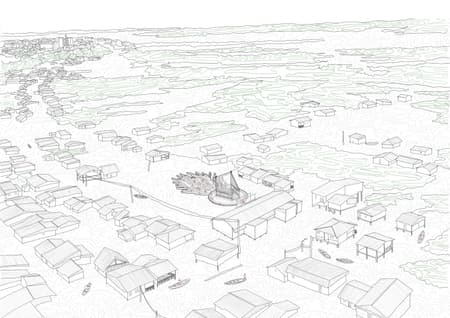
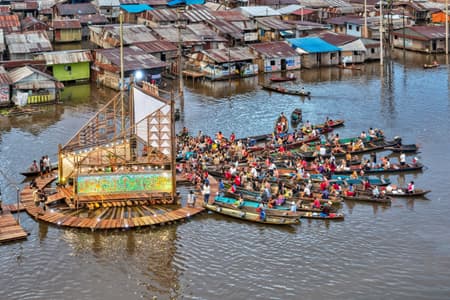
Belén, in the Peruvian Amazon, is an amphibious neighbourhood shaped by the seasonal rise and fall of the Itaya River. Between January and June, streets turn into channels and daily life is organised around canoes, stilt houses, and floating raft houses. Yet this way of life faces social, environmental, and economic pressures, compounded by state neglect. In that context, over the years, many artists and cultural associations have sustained spaces for education, gathering, and creativity.
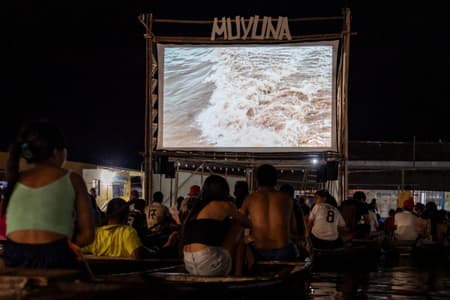
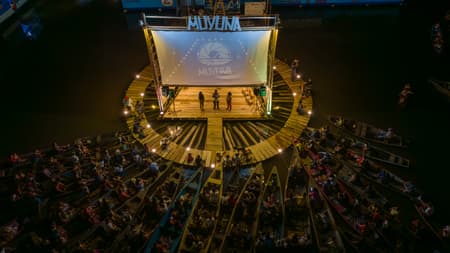
Since 2024, MuyunaFest has grown from that reality as a floating film festival in defence of the world’s rainforests. For two weeks, the neighbourhood becomes a space for audiovisual training, meeting, and public activism, and the river becomes a cinema.
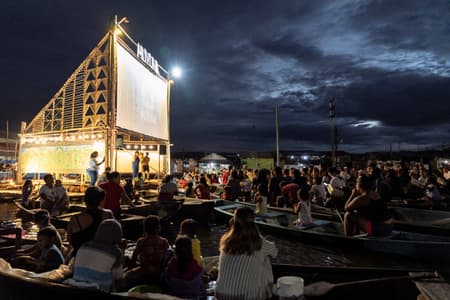
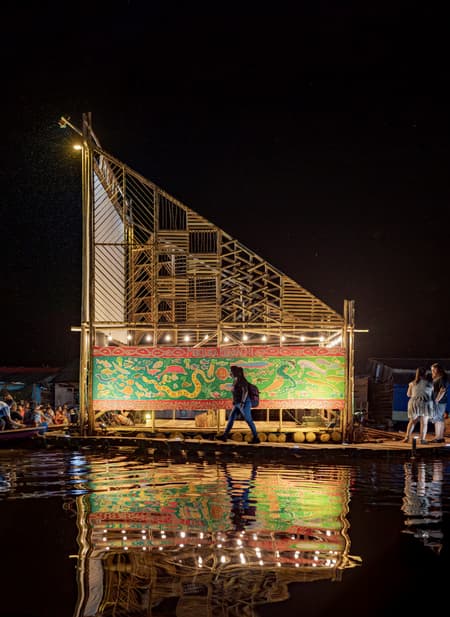
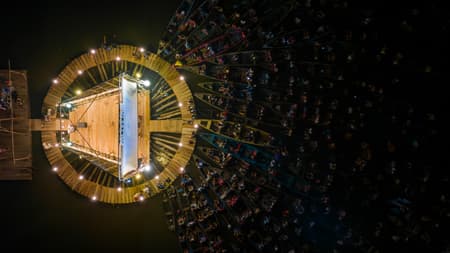
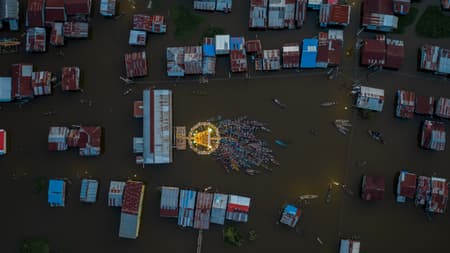
For the 2025 edition, an ephemeral structure was designed and built in front of the neighbourhood’s early childhood school. The stage was conceived through form and function, but also as a symbol. Its geometry evokes the muyuna, the whirlpool that forms where two rivers meet and, in Kukama cosmology, a gateway to underwater worlds. The Kukama were the Indigenous people honoured in that year’s festival.
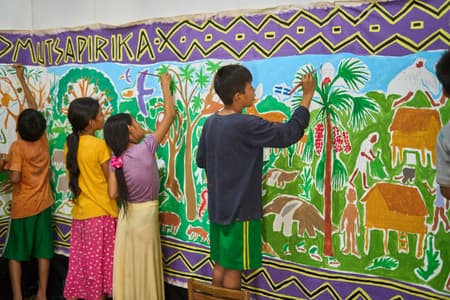
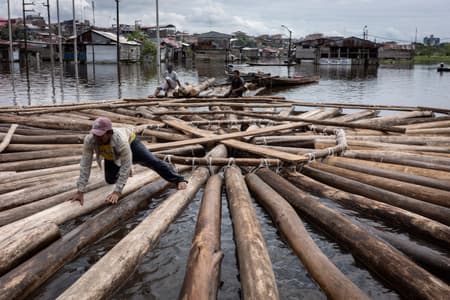
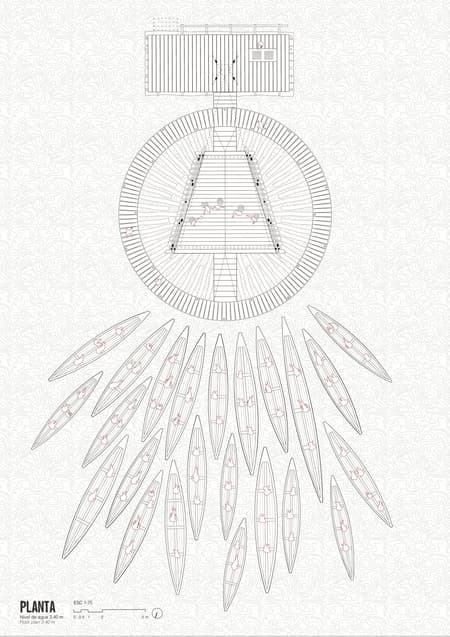
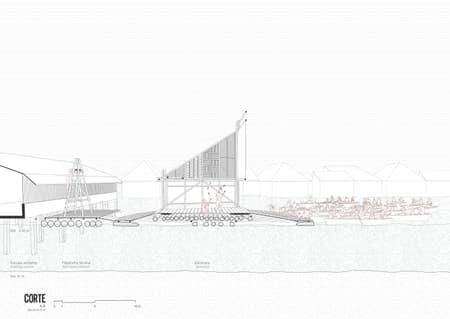
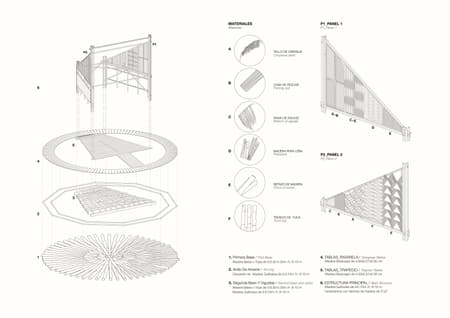
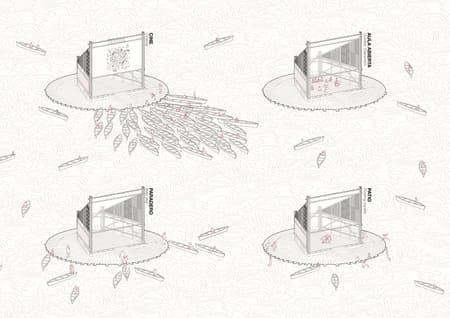
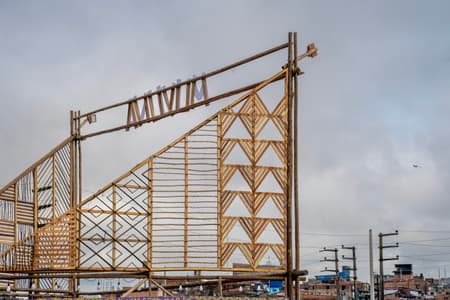
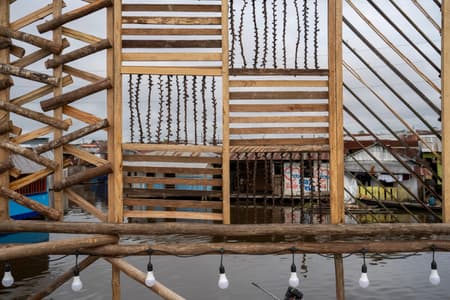
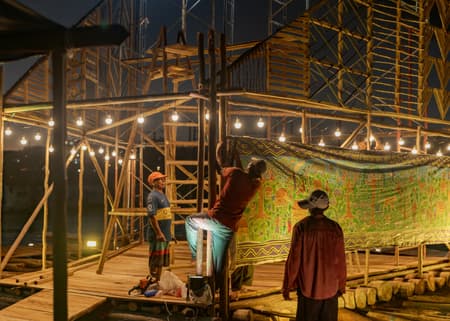
The proposal centres on a 14-metre-diameter circular platform supported by more than 70 floating topa logs, with a trapezoidal platform above that forms the stage. The entire assembly floats, with no fixed supports and no contact with the riverbed. A cinema screen rises from the platform on seven-metre-high pillars. Its sides are wrapped with vegetal elements, branches, reeds, and leaves, gathered from nearby fields, forming patterns inspired by Kukama iconography and murals developed through workshops with children, adding visual narratives rooted in Amazonian life.
The build was completed in two weeks using manual techniques and basic tools, drawing on the empirical knowledge of local builders, many of them fishers and boat makers, accustomed to constructing homes and boats in shifting water conditions. Amphibious experience guided stability and safety, while architectural tools helped resolve proportions, sightlines, and complex junctions.
During the festival days, each night more than 50 canoes gathered around the platform to watch films and performances under the stars. After the screenings, the structure remained for about a month and a half as a floating public plaza, open-air classroom, and school dock. Finally, before the water disappeared, it was dismantled and its materials were reused locally to create walkways and paths for the in-between season.
Participation here is not a one-off call, but a sustained process of joining cultural practices already present in Belén, contributing specific skills, and returning year after year. With each edition, relationships deepen, new ways of working are tested, and the festival grows closer to the neighbourhood through shared decisions, labour, and use. In May 2026, the festival will hold its third edition, expanding this approach through a carpentry training workshop in which the new stage will be the participants’ final build, strengthening local capacity for future community infrastructure and the long-term vision of an Amphibious Community Cultural Center in Belén.

_Muyuna_56.jpg?w=450&q=75&dpl=dpl_6NKhQbYoNKZ4YGsW1tKTDHjTc7uH)