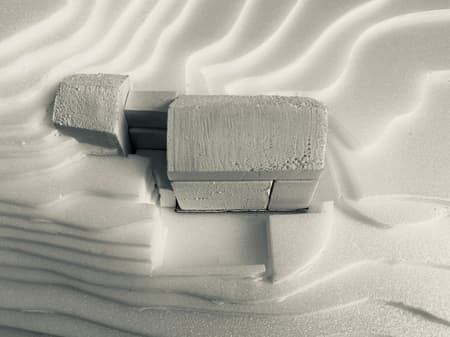
The building involved in the project is located within the rural hamlet named "Mottaccio", in the southernmost part of the territory known as "Andossi", in the municipality of Madesimo (SO). The landscape is characterized by an undulating morphology with meadows and pastures. The forest lies at a lower altitude and is clearly bounded by the maximum tree line. For this reason, the landscape features a series of vast open spaces that host small hamlets and isolated buildings. In recent decades, the mountain agriculture for which these buildings were intended has declined, leading to a progressive change in the use of the existing structures. In most cases, this has resulted in a literal and total replacement of the existing rural buildings. The Mottaccio hamlet, in its current configuration, is the result of these transformations. The materials composing the buildings have been preserved even during the most radical transformations (stone, rasopietra—flush-pointed stone, and rustic plaster). Looming over the Mottaccio hamlet at a higher altitude is a large building transformed and expanded in the 1990s called "Baitella", used for hospitality purposes. The volumetric size of the existing buildings is limited to two floors above ground. The hamlet is marked by a dirt road accessible by vehicles, which then turns southward into a mountain path leading to the hamlet of Scalcoggia.
Existing building: sizes and description As verified by cadastral research, the original building was larger, extending over several land plots. The current volume is nothing more than what remains of the oldest building. Research on Swiss-sourced aerial photogrammetry highlighted the two buildings present in 1945. This research lays the foundation for the possible reconstruction of the first land plot, whose footprint is known but for which no photographic documentation exists to determine its volumetric consistency. In all likelihood, the building developed on a single floor and was used as a storage facility for agricultural activities. The second land plot is configured on two floors: the ground floor, with a limited height of 2.00 meters, was used for sheltering animals and has a single entrance to the south; the first floor was intended for hay storage and the temporary housing of farmers. The footprint is an irregular trapezoid that widens toward the north; this layout, combined with the constant slope of the roof pitches, determines a rising ridge line that is higher to the north. The walls are made of stone with some plastered parts on the exterior and feature significant thickness. The roof covering consists of stone slabs (piode) with a wooden supporting structure. The building is characterized by an entrance balcony that provides access to the first floor via a small ramp. A series of dry-stone walls define the outdoor usable space on the ground. The openings are concentrated to the south; there is a small window to the west. The building faithfully reflects the agricultural purpose for which it was built, configuring itself as a hermetic structure with openings limited only to the necessary minimum.
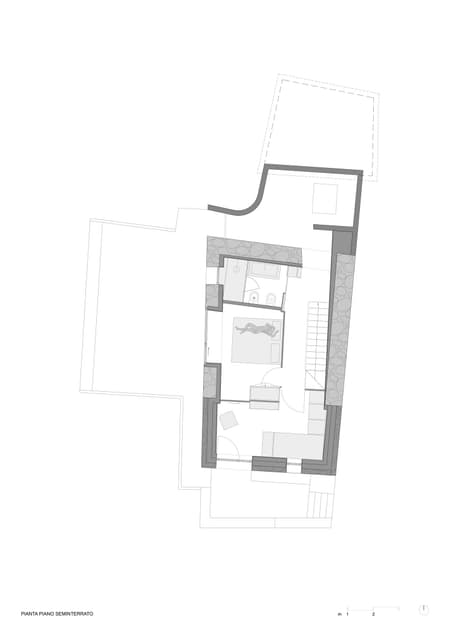
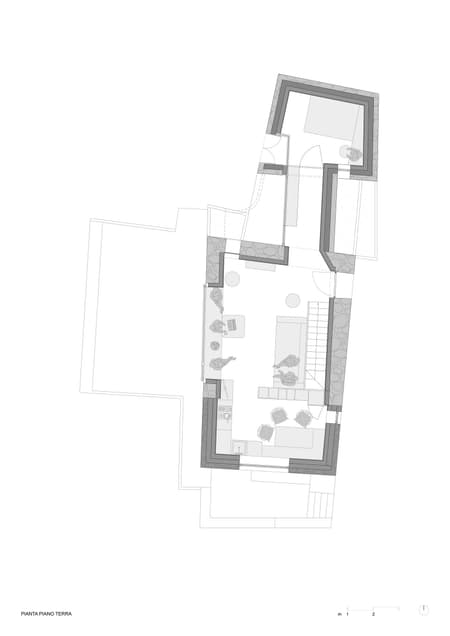
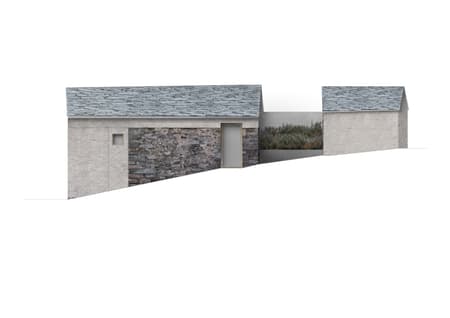
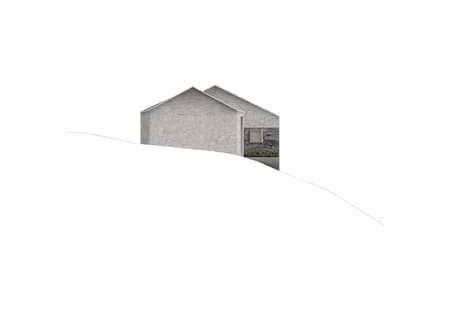
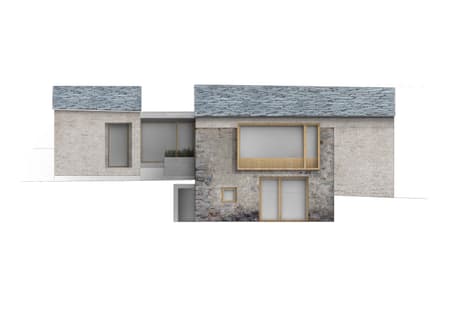
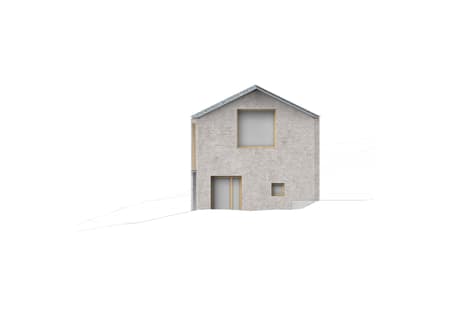
The project The project aims to make the transformation process of the building explicit: from a rural building to a seasonal residence. Since modifications are made from a volumetric standpoint, the intention is to clearly highlight any "added" elements. The building on the footprint of the first land plot is reconstructed as a single-story structure in rasopietra. It must maintain the hermetic character of the original building; for this reason, it features a single opening set back from the outer edge of the wall. This choice creates a "void" characterized by a deep shadow—as often occurs in rural buildings—rather than the reflection of a glass element. The existing main building features a horizontal wooden tie-beam on the inside, onto which the joists are anchored, cutting through the stone gable. The new roof package and the newly formed wooden structural system will create a "new wall" placed on top of the original one. To the south, the facade is demolished, and the volume is consequently extended according to the existing geometries. This part is also built in rasopietra. The intent of the project is to use a different rasopietra technique for the new parts; in this way, the different texture of the stone or the density of the plaster on the added volumes creates a dialogue between the old and the new. Thus, the formation process of the projected building emerges. The layout consists of two floors: on the ground floor is the sleeping area, composed of a bedroom, a half-bathroom, and a multipurpose room to the south. A straight staircase gives access to the living area located on the upper floor. This consists of a single open space that includes a kitchen corner. A small glazed corridor leads to the study. The living area, like the room on the ground floor, is characterized by a large glass window facing west. The south facade echoes the classic composition of rural building facades, with a French door and square windows.
The connection between the main volume and the one on the footprint of the first land plot is embedded in the ground and limited to a height of 210 cm. It features two types of facades. To the west, a glazed surface reflects the landscape and ideally evokes the separation of the two volumes; to the east, the plastered wall is supported by two planters at different levels, which will house raspberry plants. In this way, the "solid" connection will reconfigure the original layout of the long building body. The ridges of both buildings are oriented north-south. The east side, facing the public road, is designed as a blind elevation (with the exception of a small window and the entrance door); meanwhile, the west side, not visible from the public road, opens up to the landscape. The outdoor landscaping stems from the need to clear the ground floor of the west facade; a small earth movement, following the existing slope, allows for the creation of a small embankment that ends with a retaining wall 45 cm high. To the south, the existing layout is re-proposed; a small wall and a small access staircase define the outdoor usable space. In conclusion, the project utilizes traditional materials (rasopietra) to narrate a process of transformation, adapting the building to residential use while respecting the dominant landscape.


.jpg?w=450&q=75&dpl=dpl_76Rq87wxQwFvSi96M2iBpo5TN6QL)
.jpg?w=450&q=75&dpl=dpl_76Rq87wxQwFvSi96M2iBpo5TN6QL)
.jpg?w=450&q=75&dpl=dpl_76Rq87wxQwFvSi96M2iBpo5TN6QL)
_crediti ph_daniele bonetti.jpg?w=450&q=75&dpl=dpl_76Rq87wxQwFvSi96M2iBpo5TN6QL)
_crediti ph_daniele bonetti.jpg?w=450&q=75&dpl=dpl_76Rq87wxQwFvSi96M2iBpo5TN6QL)
_crediti ph_enrico scaramellini.jpg?w=450&q=75&dpl=dpl_76Rq87wxQwFvSi96M2iBpo5TN6QL)
_crediti ph_enrico scaramellini.jpg?w=450&q=75&dpl=dpl_76Rq87wxQwFvSi96M2iBpo5TN6QL)
.jpg?w=450&q=75&dpl=dpl_76Rq87wxQwFvSi96M2iBpo5TN6QL)
.jpg?w=450&q=75&dpl=dpl_76Rq87wxQwFvSi96M2iBpo5TN6QL)
.jpg?w=450&q=75&dpl=dpl_76Rq87wxQwFvSi96M2iBpo5TN6QL)
.jpg?w=450&q=75&dpl=dpl_76Rq87wxQwFvSi96M2iBpo5TN6QL)
.jpg?w=450&q=75&dpl=dpl_76Rq87wxQwFvSi96M2iBpo5TN6QL)
.jpg?w=450&q=75&dpl=dpl_76Rq87wxQwFvSi96M2iBpo5TN6QL)
.jpg?w=450&q=75&dpl=dpl_76Rq87wxQwFvSi96M2iBpo5TN6QL)
.jpg?w=450&q=75&dpl=dpl_76Rq87wxQwFvSi96M2iBpo5TN6QL)
.jpg?w=450&q=75&dpl=dpl_76Rq87wxQwFvSi96M2iBpo5TN6QL)
.jpg?w=450&q=75&dpl=dpl_76Rq87wxQwFvSi96M2iBpo5TN6QL)
.jpg?w=450&q=75&dpl=dpl_76Rq87wxQwFvSi96M2iBpo5TN6QL)
.jpg?w=450&q=75&dpl=dpl_76Rq87wxQwFvSi96M2iBpo5TN6QL)
.jpg?w=450&q=75&dpl=dpl_76Rq87wxQwFvSi96M2iBpo5TN6QL)
.jpg?w=450&q=75&dpl=dpl_76Rq87wxQwFvSi96M2iBpo5TN6QL)
.jpg?w=450&q=75&dpl=dpl_76Rq87wxQwFvSi96M2iBpo5TN6QL)
.jpg?w=450&q=75&dpl=dpl_76Rq87wxQwFvSi96M2iBpo5TN6QL)
.jpg?w=450&q=75&dpl=dpl_76Rq87wxQwFvSi96M2iBpo5TN6QL)
.jpg?w=450&q=75&dpl=dpl_76Rq87wxQwFvSi96M2iBpo5TN6QL)
.jpg?w=450&q=75&dpl=dpl_76Rq87wxQwFvSi96M2iBpo5TN6QL)
.jpg?w=450&q=75&dpl=dpl_76Rq87wxQwFvSi96M2iBpo5TN6QL)
.jpg?w=450&q=75&dpl=dpl_76Rq87wxQwFvSi96M2iBpo5TN6QL)
.jpg?w=450&q=75&dpl=dpl_76Rq87wxQwFvSi96M2iBpo5TN6QL)
.jpg?w=450&q=75&dpl=dpl_76Rq87wxQwFvSi96M2iBpo5TN6QL)
.jpg?w=450&q=75&dpl=dpl_76Rq87wxQwFvSi96M2iBpo5TN6QL)
.jpg?w=450&q=75&dpl=dpl_76Rq87wxQwFvSi96M2iBpo5TN6QL)