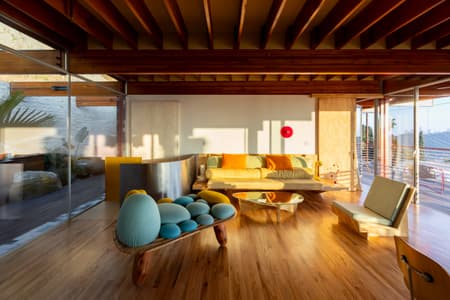
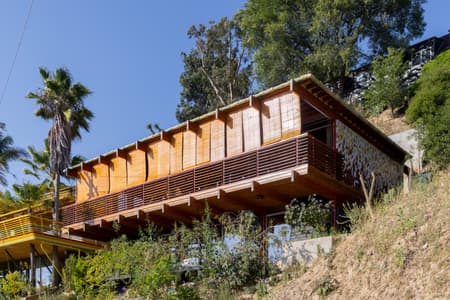
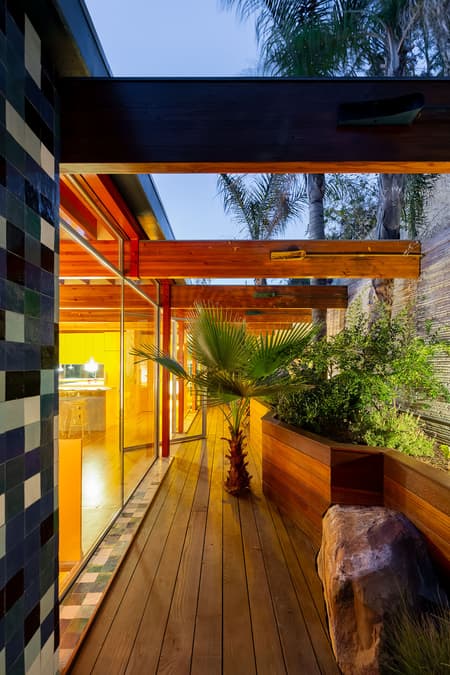
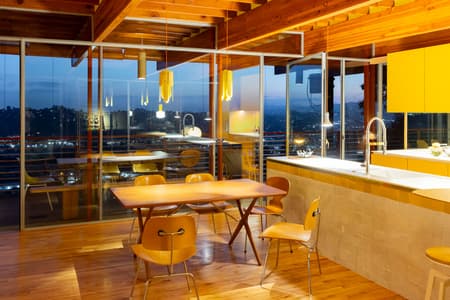
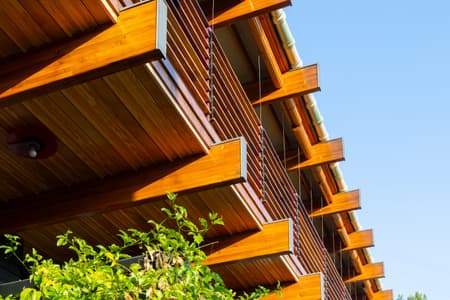
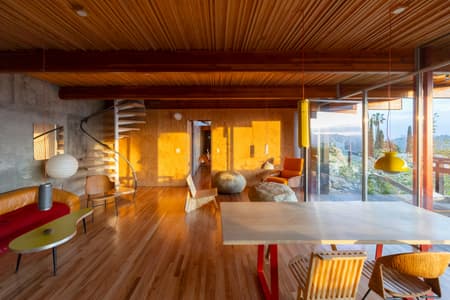
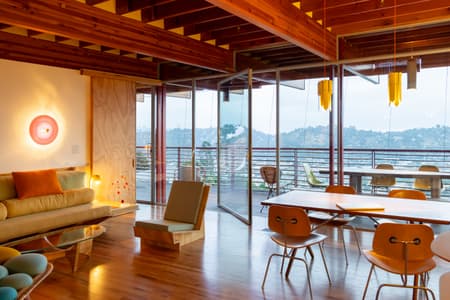
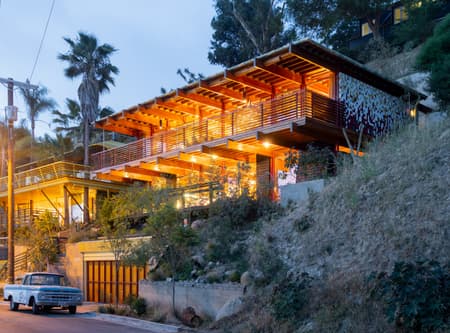
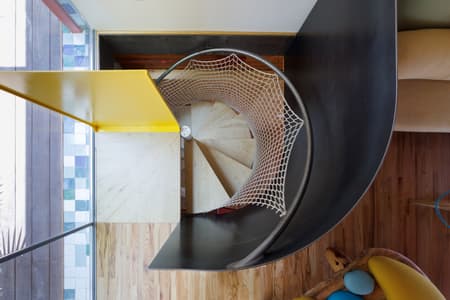
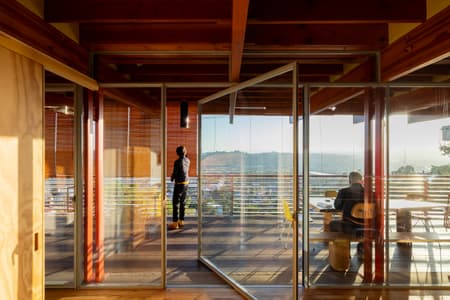
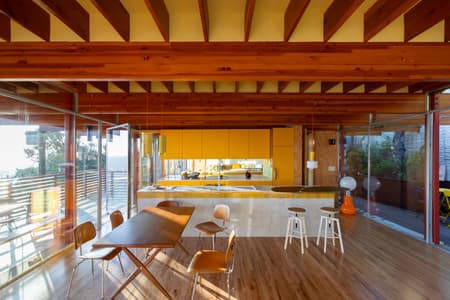
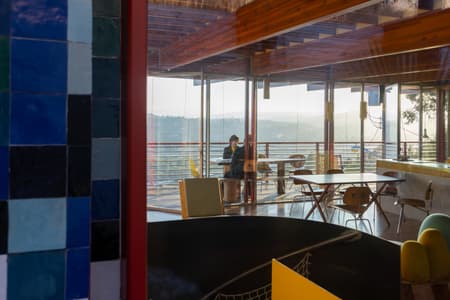
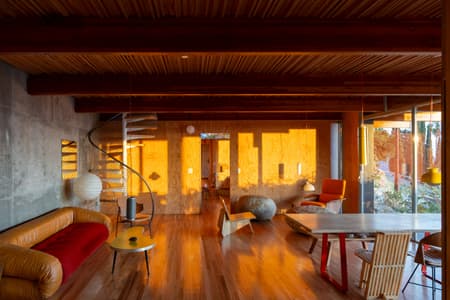
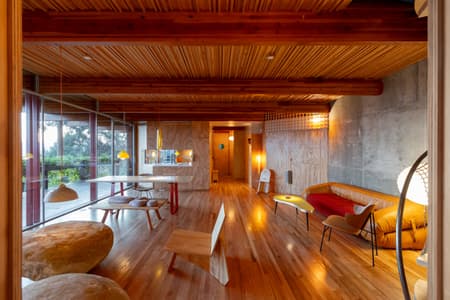
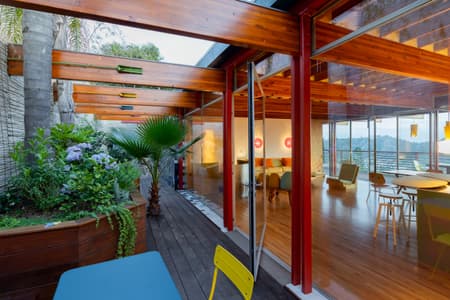
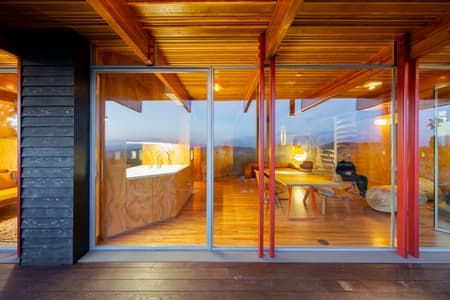
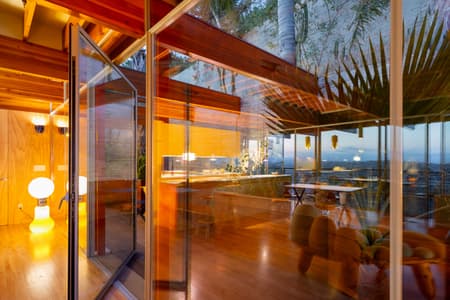
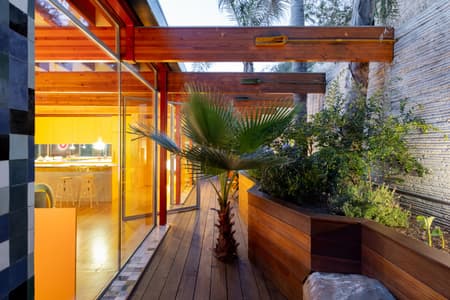
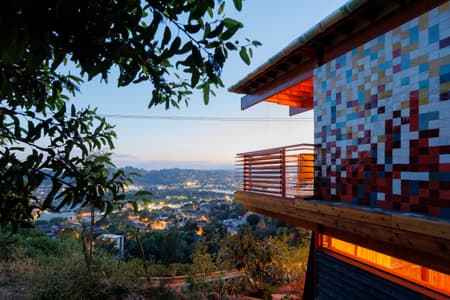
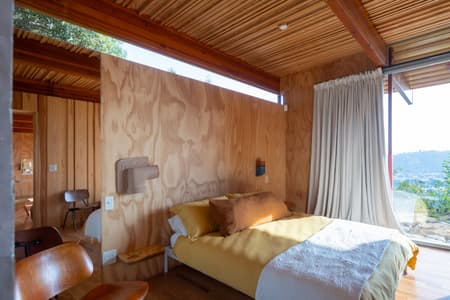
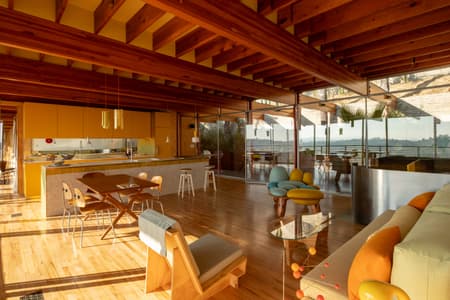
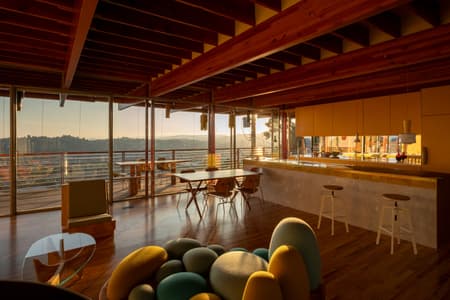
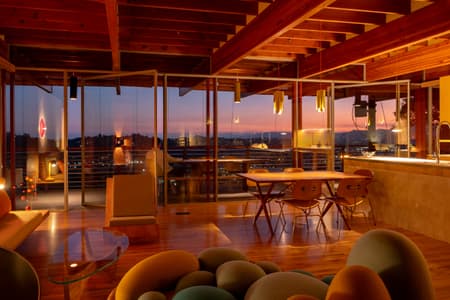
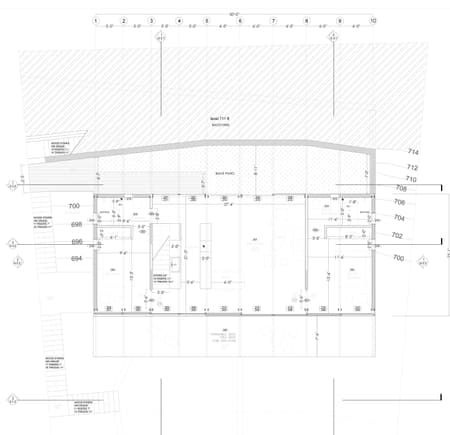
The Cano House by Diego Cano-Lasso is a contemporary reinterpretation of mid century post-and-beam architecture in Los Angeles, California. The goal was to create a lightweight structure that cantilevers over the hillside and extends toward the city. The result is a sequence of slender steel posts supporting 42-foot-long wooden beams that appear to project beyond the house toward the horizon. The enclosure consists of continuous glazing with pivot doors that frame and reflect different views of the city as they open and close. The house is embedded into the hillside, requiring the excavation and removal of more than 50 truckloads of earth. Its light structure and dramatic cantilever help blend the architecture into the landscape, minimizing its visual impact on the site. The structural lightness of the house recalls a defining characteristic of mid century architecture, an approach that, while once common, is rarely pursued in contemporary residential construction.
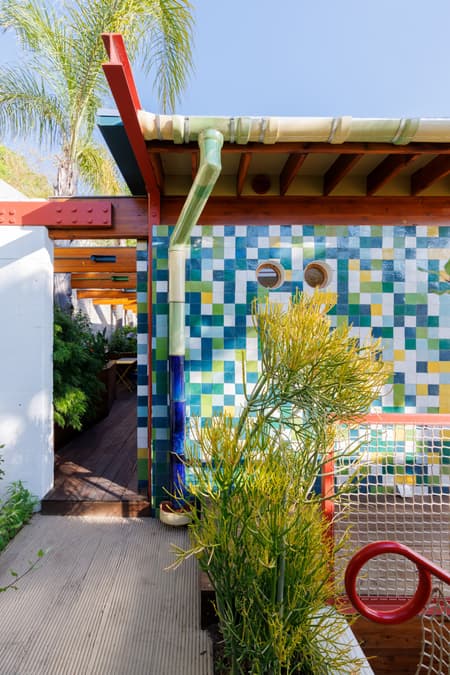
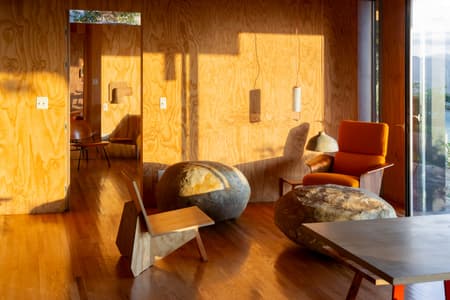
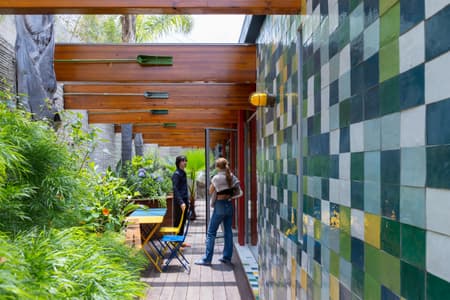
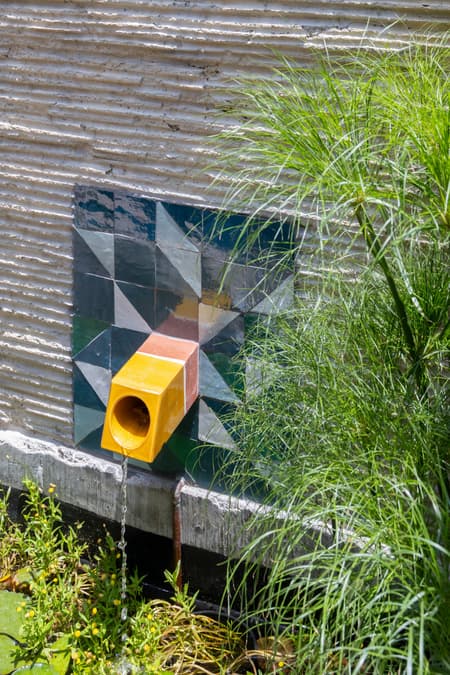
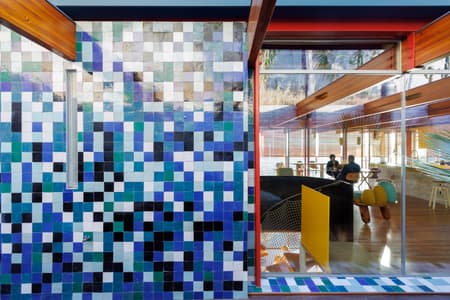
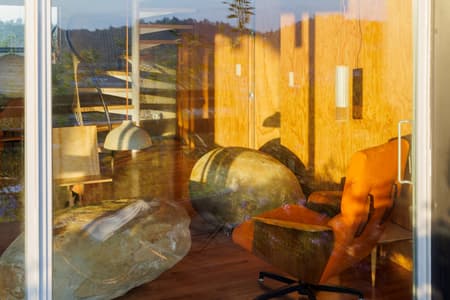
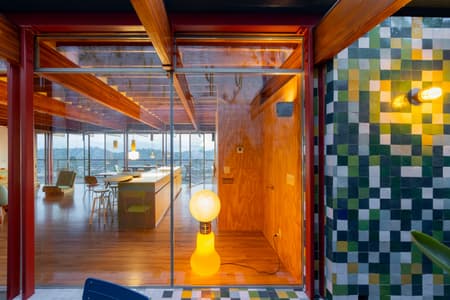
Construction was interrupted by the COVID-19 pandemic. When work resumed, labor shortages and increased material costs had transformed the construction industry, forcing the development of creative self-building solutions. The side elevations are the only solid facades and are clad with zellige tile murals designed and built by Doctor Cato (Alejandro Cano). Ceramic gutters imported from Spain were repurposed, with some sections transformed into custom lampshades. Door handles were crafted from stones collected on the beaches of Southern California, while ceiling lamps were sourced from the Spanish lighting studio Luz Mixtura. Boulders uncovered during excavation were brought into the house and repurposed as coffee tables, further connecting the architecture to its site. Doctor Cato also designed and built numerous furniture pieces inspired by the work of Frank Lloyd Wright and R.M. Schindler.
“Only by crafting every detail and element would the house truly feel like my home.”
This is what I realized after three years spent building my own house in Los Angeles, California.
“You’ve always had the desire for a home—your home—enveloping you in a friendly atmosphere for work and for doing nothing. But at first you didn’t know (because you would learn it later, after living among strangers) that behind your desire, and blended with it, was another: that of a refuge filled with the friendship of your things. Everything else would remain outside, but inside would be you and what is yours.
One day, when you had already begun rolling around the world, dreaming of your home but without one, an unexpected event finally presented you with the chance to have one. And you began to build it around yourself: simple, bright, welcoming—a table, books, a lamp, an atmosphere scented by the flowers of the season.
But it was too light, and your life too uncertain, to last very long. One day, another day, it disappeared as unexpectedly as it had come. And you went on rolling across so many lands, some of which you had never even wanted to know. How many plans for a home you have had since then, nearly realized, only to be lost again later.”
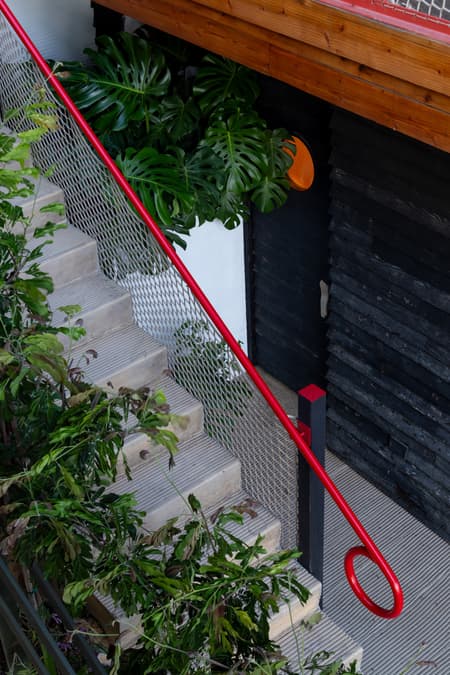
Everything in this house was custom-made—from the lamps to the door handles, from the structural system to the wall finishes.
It all began about fourteen years ago while driving my 1962 Buick convertible through Los Angeles. For a European like myself, it was shocking to find vacant land in the “center” of the city—if American cities ever have a center.
It did not require much money to purchase one of those empty lots. Soon, like Buck Stahl forty years before me, I was dreaming of building a house that would cantilever over Los Angeles.
Cheap land here is often referred to as “unbuildable,” and this site was no exception. But my dream, fueled by Julius Shulman’s iconic photographs of the Stahl House, was too strong to ignore. I had moved to California in search of the lifestyle I had seen in the movies—the lifestyle that gave rise to an architecture of light, color, and optimism. I wanted to follow that tradition: the architecture of Mid-Century Modernism.
So I pushed, and pushed, and worked relentlessly through neighborhood opposition and bureaucratic obstacles until, three years later, I finally received approval to build on this “unbuildable” land.
Many stories accumulated during the years spent building on the hillside—some of them alone, some alongside the Mexicans whose presence makes this city even more surreal than it already seems.
Eventually, the house was enclosed, with its roof and windows in place. Yet it still lacked a personality of its own, like a teenager hiding beneath a hoodie.
And just when this “teenager” was about to become a house, something unexpected happened, something that taught me to always be ready for sudden changes: the 2020 Covid pandemic.
Three years passed before I could return to work on the house. When I arrived, I barely recognized it. An abandoned construction site is… a depressing sight. The construction industry had changed dramatically. Labor was scarce, materials had become prohibitively expensive, and the crews I had worked with were gone.
It was then that I realized there was only one meaningful way to finish the house: to build it ourselves—my brother, my wife, some friends, and me. It was also then that I understood that only by crafting every detail and element would the house truly feel like my home.
So we did. And every time a decision had to be made, we chose the creative path rather than the easy one.
One day, we finished. We cheered and celebrated.
And then the house disappeared from our lives as unexpectedly as it had arrived.