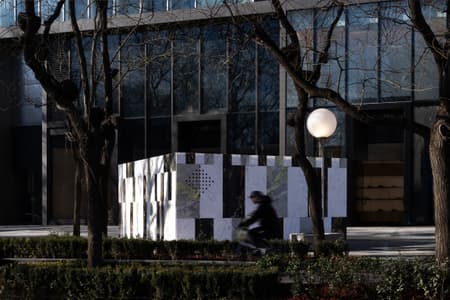
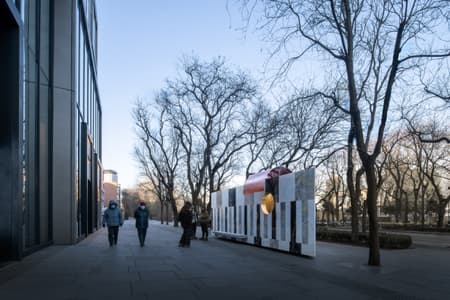
This temporary architecture was imagined as an alien presence within a context lacking clear reference points —an object whose origin remains ambiguous, as though it had simply fallen from above. A triangular mass of metamorphic stone asserts itself along a tree-lined avenue in Beijing’s commercial core, firm and indifferent to its surroundings.
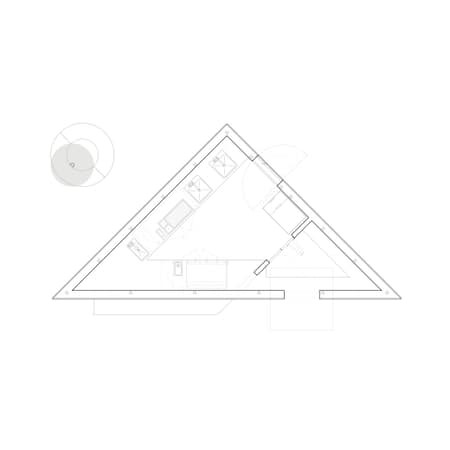
A deliberate, almost defiant gesture—tempered by a trust in the clarity of essential form—guides the entire design approach. The triangle, primordial geometric figures, holds within it a quiet structural stability. It acts like a wedge inserted into the city, mediating between logic and feeling.
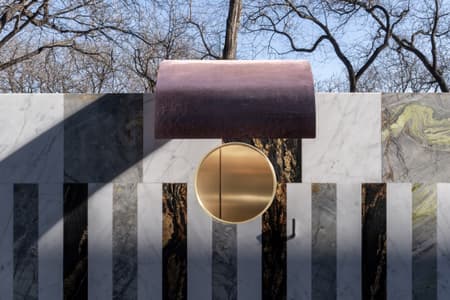
Its three faces are articulated through distinct marbles: tones of gray-white and black-gold are interrupted by a subtle green, a restrained yet intriguing presence. The material’s inherent textures and colors, precisely cut and rhythmically composed, reframe the stone’s natural richness into a renewed vitality.
The compositional order is suddenly broken by a circular aperture, from which a warm, diffused light emanates, as if from the project’s inner core. A beaten copper element extends outward, catching and reflecting light, introducing a softer, almost tactile dimension that contrasts with the otherwise austere volume.
Despite its mass, the structure resists heaviness. Slightly lifted from the ground, it creates a shadowed void beneath, diminishing its visual weight and suggesting an unseen force holding it in suspension. This subtle detachment generates a quiet tension, allowing the pavilion to feel both grounded and hovering at once.
Within the continuous flow of the city, where movement rarely pauses, this object establishes a moment of stillness. It becomes not just an inert form, but a presence—one that engages passersby, slows perception, and gently alters the rhythm of time.