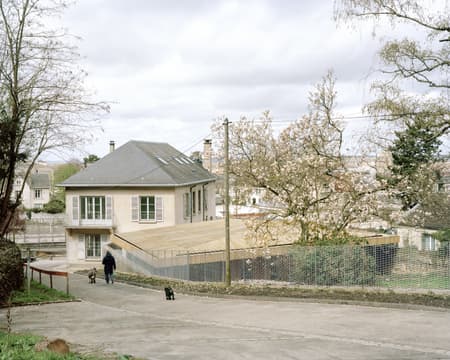


The site, of a rare peculiarity, is small and enclosed by a magnificent clapas wall, typical of the region. Alongside this, given the historical mineral character of the town of Uzès, the use of solid stone became essential.
The project thus takes the form of a vast rectangular mass of solid stone nestled between the existing dry-stone walls. To the west, it asserts its monolithic character with an imposing wall facing the road and subtly revealing the entrance. This radical gesture allows the east façade to be entirely open, offering the living spaces both intimate and unobstructed views of the garden and its olive trees.
The house was then oriented to take advantage of the prevailing wind, and the constraints imposed by the 80 cm elevation, necessitated by flood risks, were used to transform the service void into a large ventilation shaft running the length of the building. This configuration cools and oxygenates the patio pools that pierce the stone structure. Thus, each living space has its own secluded haven of coolness, evoking the tranquility of the Place aux Herbes, the true heart of Uzès' historic center. Some rooms are completely disconnected from the outside world, offering only the stone pulsating in rhythm with the pools, contributing to the house's unique and intimate atmosphere.
In plan, the project unfolds like a long corridor of terraced spaces, punctuated by several stone stelae, descending towards the south. At its far end lies the most elegant section, with generous proportions and breathtaking views of the garden. This part of the house can be completely independent of the rest, thus perfectly adapting to the clients' lifestyle.
This long stone rectangle was designed according to the local quarry's machining standards, which optimized costs and simplified the construction process. However, plays on angles, orientations, and imbalances were incorporated to reinterpret the principle of the clapas (a type of stone block) in a contemporary way, thus animating the façade. For added compositional interest, we varied the stone hues and added touches of color and reflections, bringing increased dynamism to the façade and roof of the project. In contrast to the massive and static appearance of the stone columns, moving curtains introduce another sense of freshness and lightness.
To complete this project, a swimming pool, created using cylinders extracted from the core samples taken from the house's stones, finalizes the composition by offering a captivating perspective towards the existing stone hut. This pool, in harmony with the landscape, serves as a transition between the modernity of the main house and this former shepherd's hut.